BEYOND THE NATION
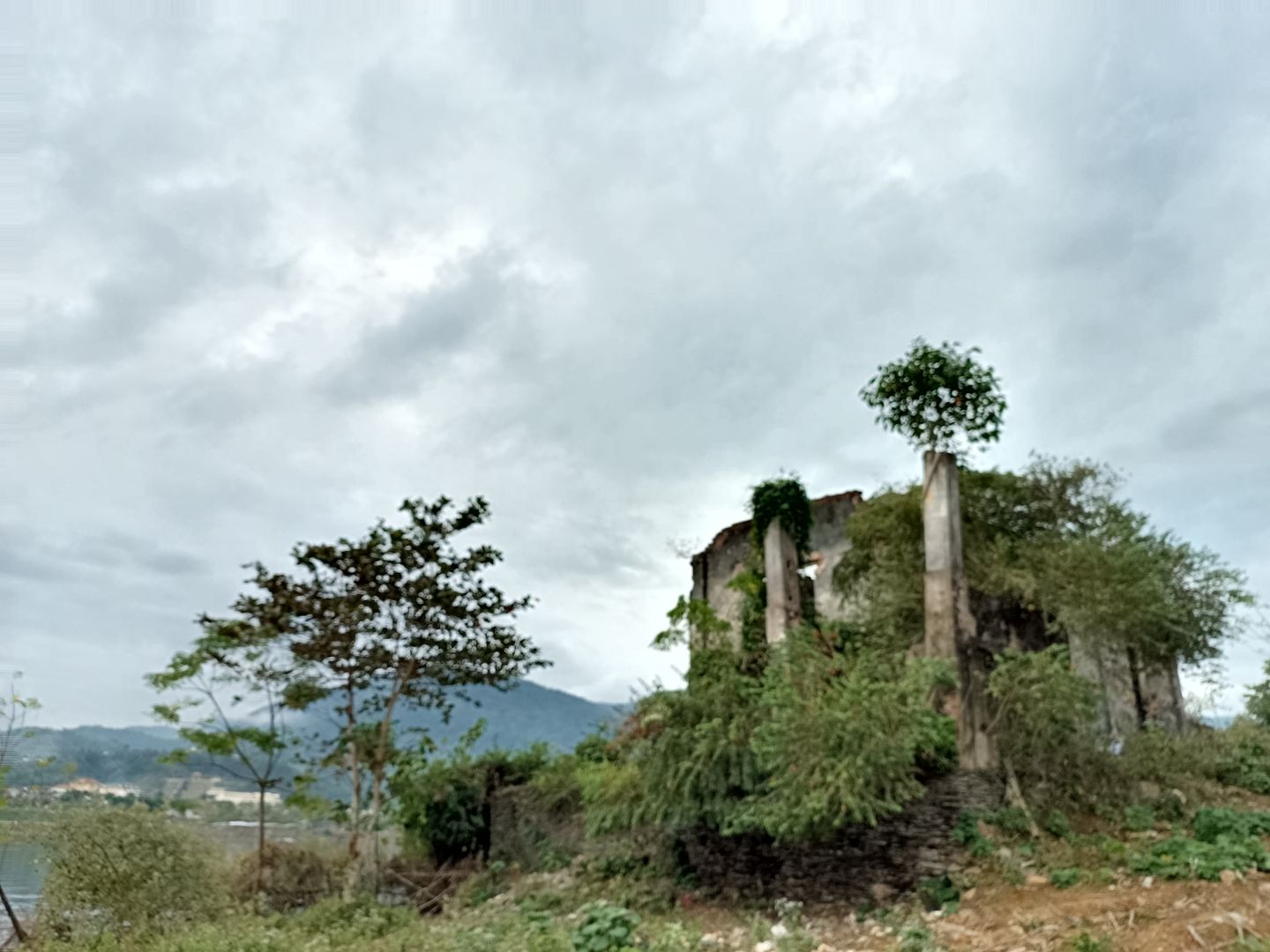 The ruins of the house of the son of the “plunderer” of Luang Prabang, Lau Chau Province, North-West Vietnam
For the more empathetic, the city of Luang Prabang might turn out to be a delightful discovery. As one immerses oneself in listening to them, its streets reveal seductive magnetic fields, as if the community that inhabits them were traversed by a feminine force capable of enchanting the passing traveller. At a first superficial glance one immediately notices that this is an “Instagrammable” city, full of perfect frames waiting to be captured by the “story of Me in the world” broadcast on social networks. Scrolling through the various YouTube, Instagram, WhatsApp, TikTok or Facebook feeds, a narcissistic component of the place emerges, one that describes certain aspects of the feminine forces I wish to address. Indeed, the inhabitants of Luang Prabang spend long stretches of their working day keeping the landscape unaltered—that is, materially caring for outdoor and indoor spaces so as to continuously clean up the environments in which the tourists' “social” experience in the city takes place and is staged. The vintage restorations and the old colonial houses are the image of a beauty that observes and narrates itself in a social narrative that positions the city in a niche of post-industrial capitalism. The product one purchases is a digitally documented being-there among its orderly, soberly coloured streets. This happens in a region, Southeast Asia, where tourism is rapidly establishing itself as one of the major industries, both in terms of employment and because of its solid connections with the construction sector.
There is then a further stratification of the feminine forces that pass through these places. This care of spaces is in fact also a care of the “self,” understood here as the body. In Luang Prabang, as by now in many other places in the region, the so-called economies of intimacy—or, precisely, of the “care of the self,” to put it with Foucault—are proliferating. Among these, the first to present themselves to the more hurried gaze are the massage centres, which employ mostly young women. But a more attentive gaze could not fail to include within the category of “care” the “Buddhist Temple” as well. Here it is young men who are hosted. Both institutions are centred on hospitality, and, while living within a clear division of gender, they seem functionally to serve analogous purposes. Alongside thousands of monks there are, as a mirror image, thousands of masseuses. Thus, albeit along different trajectories, the two institutions attend to the pacification of the senses and of existential fatigues. Historically, too, the Buddhist temple and the massage centre were bound together indissolubly. Thai massage is the most widely recognized today and has recently entered the intangible cultural heritage of humanity. It is said to have been born precisely in the Buddhist temples of Bangkok and Chiang Mai, where a body of knowledge was systematized that came directly from the Buddha, who is said to have been massaged by expert masseuses during his pilgrimages. “Traditional” massages exist throughout the region, from Burma to Vietnam, from southern China to Thailand. Together with the Buddhist temple, the massage centres form an alliance of feeling in which the care of the self concerns modalities and forms of subjectivation.
It thus happens that in the public space of the encounter between visitors, workers and inhabitants—beyond the aesthetic experience of the landscape to be contemplated and within which one comes to be “contemplated” or “Instagrammed”—there is an equally important dimension, more intimate and subjective, in which local entrepreneurs are developing services aimed at the production of well-being. There are, for instance, “mindful” hotels and “energetic” massage centres in which workers are trained to create a deep empathic capacity with the tourist, to the point—in some cases of local excellence—of producing an experience of total relaxation, from the morning coffee to the bedtime herbal tea. The development of this kind of service has by now become a genuine competitive factor, both regionally and locally, and it concerns training pathways for a workforce that must be able to grasp the most hidden nuances of the clients' desires. The marketing objective is always to sell an unrepeatable and/or special experience of hospitality, and, in order to excel at this task, some hotels want their workers to live inside the hotel structures themselves rather than returning to the dormitory neighbourhoods where they would normally lodge. This obligatory—or strongly recommended, if one intends to work in the hospitality sector—communal life would have as its very purpose the incorporation of “total service,” that is, a more complete understanding of the experience of hospitality such as to enable the worker to respond to the tourist's need for care almost with a single glance.
However, for someone like me who comes from more markedly machista as well as patriarchal cultures, within these fields of force one might also glimpse something else, as if this magic of the streets were also the product of peculiar political and social organizations whose roots reach into historical epochs well prior to the colonial encounter. In the coming pages I will try to clarify better this third stratification of the feminine forces of these places. It seems important to me to describe them before I venture into the “Lao ethnic question.” To do so, however, I will move in a field different from those I have traversed so far. That is, I will concern myself with the study of myths, as they emerge both in local storytelling and in artistic and religious literary production. The aim is to show the existence in these lands of a matriarchy never fully subjugated to the colonial and neocolonial political structures. I will then show how the use of women as a “diplomatic object” but also as a “sacrificial object” to establish alliances and to found lineages and property rights has always underpinned political systems that were plastic and highly adaptable to the varying conditions of the world. From here I will observe the current becoming-queer of the city's leadership as a historical continuity and as a political modality of the city that responds, today as yesterday, to the atavistic fear of yet another cultural apocalypse, as De Martino might perhaps define it: the fear of an invasion, ethical as much as material, that according to some is threatening the identity of Luang Prabang and of Laos more generally.
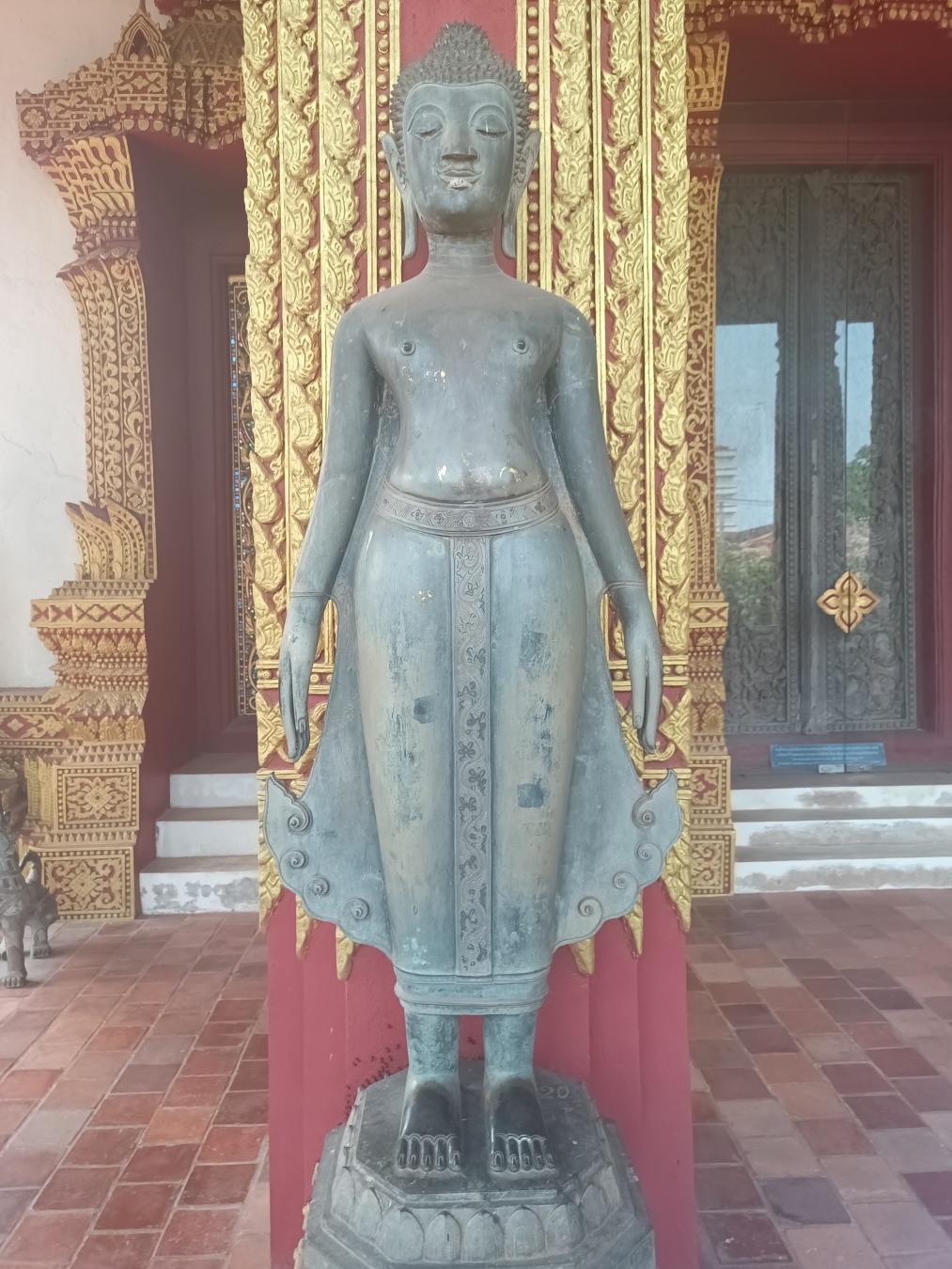 Feminine Buddha in the imperturbable posture of the Luang Prabang school, Wat Ho Phra Keo Museum, Vientiane, Laos
The Galactic Polities
When the first French explorer arrived in present-day Laos he came by way of the Khorat plateau, in northern Thailand, with two elephants and a small caravan that had been placed at his disposal by the Viceroy of that same region. With him he carried a letter of safe conduct that he was to show to the various Lao clan chiefs. Moreover, he had been given drums with which he was to announce his arrival before entering the villages, so as to be sure of being welcomed and given hospitality. In 1846, Henry Mohout—who for many Europeans is still the “discoverer” of the temples of Angkor—crossed the Mekong for the first time, probably without knowing that twenty years before his arrival the city that stretched along the lands he was treading, beyond the Khorat plateau and the Mekong, Vientiane, had been razed to the ground by the army of Siam—that is, by the very same Viceroy who had given him that safe-conduct. In his diaries Mohout describes the surprise with which he observed all the “primitives” who lined up docilely upon hearing the regal sounds of Siam, and the clan chiefs who prostrated themselves before him after receiving the missive of the Viceroy of Khorat. In a few weeks he managed to travel up the great river until he discovered a city, Luang Prabang, with which he probably fell in love, but where, a short time later, he met his death from the bite of a mosquito.
After him, other French explorers arrived in Luang Prabang and described its fascinating beauty. Chief among them all was certainly the one who later became its Vice-Consul, Auguste Pavie. In his diaries he described his entrance into the city as though he found himself somewhere on Lake Como or Lake Constance. And he already imagined embellishing the landscape with a “French” villa here and there. It took Pavie ten days to meet the King in an official audience. For the occasion a gate of wood and bamboo was erected, under which he was made to pass after having spent the preceding days “outside” the city. He lodged in a house on the right bank of the Mekong, opposite the city, where the kings had their lands for hunting and where, from the first half of the 1800s, they also went to meditate. He was given local guides who took care of him, showing him the surrounding villages without ever letting him approach the centre. He was also taken to visit the tomb of his predecessor, on the bend of a tributary of the Mekong, which at the time was reachable only by boat. In his diaries Pavie does not seem aware of all the ritual implications of his arrival in the city. Nevertheless, the reception he received very probably represented a classic rite of purification/passage that culminated in a ceremony before the entire population, in a public space set up on the city's main street, right next to the King's residence.
At that moment, certainly, neither King Oun Kham nor Pavie knew that after about twenty years that kind of “diplomatic” encounter would conform to “international” rules and would take place privately, in the throne room of the Royal Palace, designed by French architects at the beginning of the 1900s. The building was the first of its kind in the history of the city, but also in the whole region of the middle Mekong. Never before had a civil architectural structure surpassed the city's temples in grandeur and “eternity.” The building rose towards the sky as did the imperial residences of Hue in Vietnam, or the Forbidden City of Beijing, or the residences of the Kings of Siam. But in the Kingdom of the Million Elephants, the King did not fulfil this cosmological function. The King of Luang Prabang, who nonetheless sought to present himself as Indra (God) and as Bodhisattva (future Buddha), coexisted with other local and regional powers that did not allow his institution to fully theocratize and Indianize itself. The stupa that was built on the roof of the palace, right above the position of the throne, and that ideally raised the King of Luang Prabang towards the sky, was a religious ornament that had never been used for the dwelling of a person, however important, such as the King of Luang Prabang. This and other architectural elements were introduced by the French and marked a break with the past of the political systems of the central Mekong. Certainly, the Kings of Luang Prabang had always been engaged in the creation of monasteries that could raise their status towards divinity. But such aspiration was directed primarily at a local recognition, where the kings competed with other potentates and clans. Other important families of present-day Laos—such as, for example, the King of Xiengkhuang (of the Plain of Jars), who was undergoing an equally important process of building a “state Buddhism”—did not recognize the new “sovereign power” of the King of Luang Prabang. In his diaries, Pavie is not conscious of these implications, and probably the colonial administrators never troubled themselves to understand them fully. Nor does he mention whether, during the phase of “cleansing” in which he was kept, he was permitted to smoke opium and to have ladies of company, to whom the most important guests were usually invited. The women of Luang Prabang in fact fulfilled multiple functions vital to the kingdom and determined the very capacity for power of the King.
The exchange of “virgins” was the basis of alliances between villages practically for as long as local history has been told. The founding myths I have heard around the city almost all coincide in one detail. In order to occupy lands legitimately, chiefs had to give one of their daughters in pledge—or, in other versions, the most beautiful woman of the village—to the King of Luang Prabang. At the basis of the alliance being proposed there was, that is, a “property right” acquired through the sacrifice/gift of a woman. The alliance also sanctioned the acceptance of a superior force from which protection was sought. Some texts written in the 1970s that investigate the animist cults of the central Mekong region mention a third founding modality for an urban settlement: the sacrifice of a pregnant woman, though not to the King but to the gods (on this see Condominas). This third case presents more than one element of interest, since it might testify to the existence of urban centres organized around a matriarchy. The sacrifice/gift produced an imperishable spirit, called Phi, which remained forever bound to the places where the sacrifice occurred. Though in different forms, this cult persists even today. The Phi, that is, possesses a fundamental characteristic: it is immanent to places, and, having no ethical nature—neither good nor bad—any rites of “reclamation-cleansing” by shamans, exorcists and magicians do not produce its disappearance or a change in its form. “Forgetting” that Phi therefore has no concrete effects. Its remembrance, however, helps to keep places in peace and in balance. In other words, the Phi of a place resembles a shared memory of the mythical past of the territories. Its interpretation, like its forgetting, is certainly a political matter. Rather as is happening to me who rewrite it, the inhabitants, at a certain point in their lives, simply “know that there is a Phi there” and act accordingly, bringing offerings or avoiding those places. According to Buddhist believers, the Phi are part of a superstitious world in which events can be influenced by occult powers of every kind. And yet one of the greatest peculiarities of the Buddhism of Luang Prabang is precisely their persistence in the daily religious practices of the population (for a more thorough treatment of the theme see Holt). What is very interesting for the purposes of this writing, however, is that some founding myths of the region's major urban centres had feminine tutelary spirits, as though they were ancestral reminiscences of an original matriarchy upon which life among the villages was ordered before being replaced by the regal patriarchy.
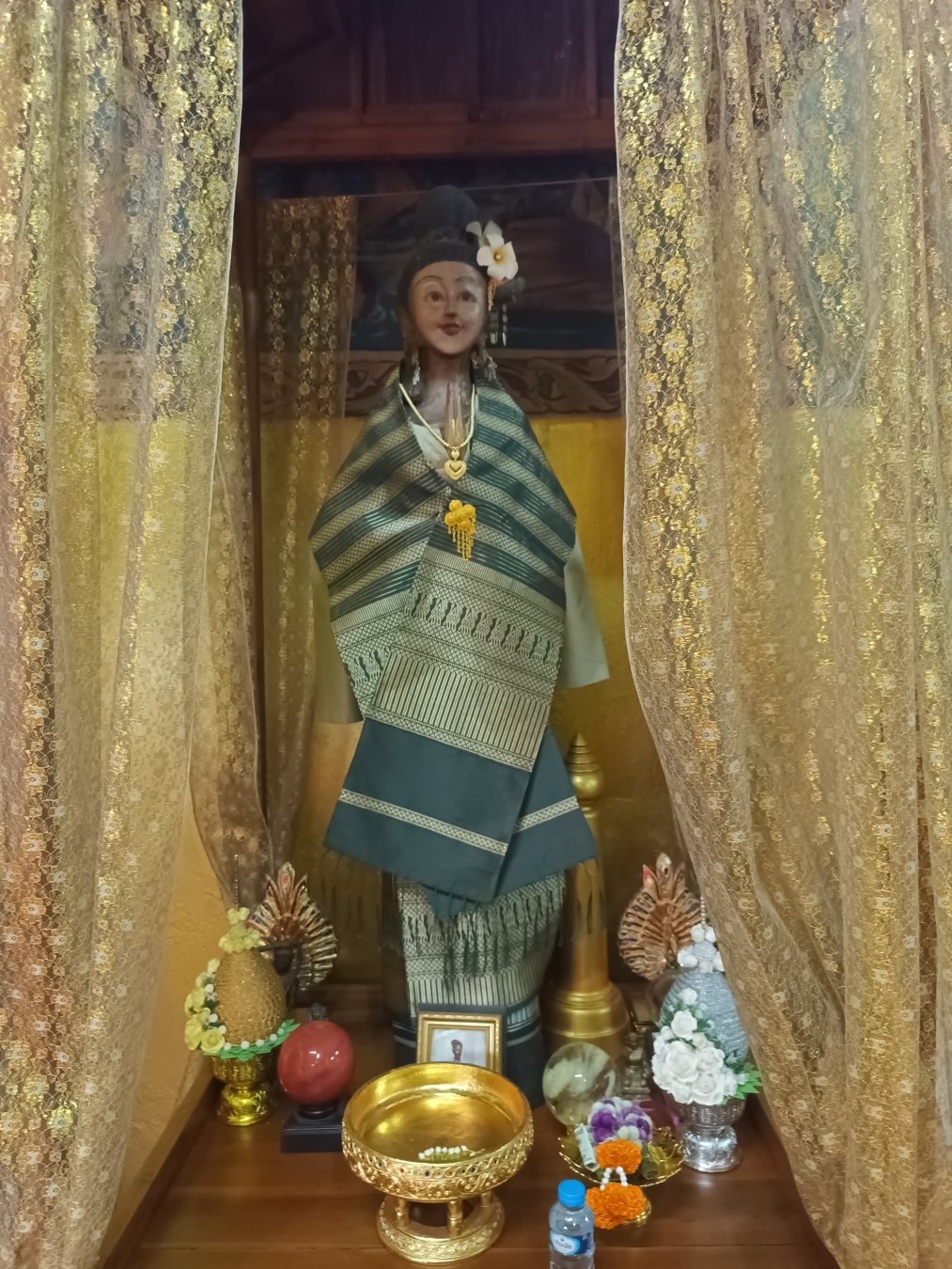 Chao Mae Simuang, cult of the feminine tutelary spirit in Wat Simuang, Vientiane, Laos
In the kingdom of Lan Xang, several edicts expressly forbade the cult of the Phi and initiated campaigns for their erasure and replacement, which included the construction of Buddhist altars and temples over the places where the Phi were remembered. It is important to stress, however, that often the cult of a Phi was associated with charismatic leaders of various kinds who, in different historical phases, could aspire to replace or compete with the royal family. Around the Phi could arise groups that shared a set of rites and cults giving rise to totemic myths and ancestral clans, often in conflict or competition with those celebrated instead by the royal family. These were genuine cosmological battles fought with rituals and beliefs which, when not absorbed by Buddhism, could also erupt into rebellions and revolts. In regional anthropological studies there exists a specific political category, that of the “Big Man,” which describes organizations hierarchized around these apical figures, often parallel to, or intertwined with, the more formal ones of the Buddhist King. At their apex there tended to be men who, besides wealth, were said to possess healing powers, and for this reason they were “men of power.” In local history many of these “charismatic” leaders ended up supporting and organizing rebellions which, though sporadic, represent, to this day, the only known moments of mass public opposition to the political power among the Lao communities. The processes of Indianization of the King were therefore aimed primarily at ordering these minor cults and subjugating them to a religion that instead had to be considered true and just—Buddhism, that is—and for this reason the King had to embody all its ethical teachings. Nevertheless, for long historical periods Buddhism was the “noble” religion that distinguished the royal family from the rest of the people, who instead mixed animism and Buddhism.
Within this cosmological conflict there is probably hidden the replacement of the original matriarchy, of which, even today, traces remain in the inheritance systems of the Lao villages. To a charismatic patriarchy there was added, and then imposed, a system of Buddhist karmic laws that found their fulfilment in the Indianized King. But, as written earlier, in Luang Prabang this assimilation was never complete; indeed, it was the French Colony that attempted to complete the process, for obvious reasons of territorial control. What certainly did happen was that in the passage from matriarchy to patriarchy, the woman, from being the focal centre of the organizational structure, took on a value that was economic and exchange-based as much as symbolic. The King of Luang Prabang, in order to be “King,” had to possess many of them, and they had to come from all the kingdoms and all the major houses of the region: he accumulated them and he exchanged them. When Pavie arrived in Luang Prabang he wrote that King Oun Kham had at least 60 concubines, by whom he had had a barely quantifiable number of sons and daughters, and that they all lived in what is today called the “UNESCO Peninsula.” Possessing women was not, however, merely a measure of the capacity for power. The King of Luang Prabang also performed an important reproductive function. He had to guarantee the eternal survival of his people in a region that had often known the annihilation of villages and cities. That is, he represented the continuation of a mythical genealogy that some totemic legends traced back to Khoun Boulom, to the founder of a legendary kingdom that brought together the whole region stretching from the Red River and Dai Viet all the way to the Irrawaddy and to Pegu, passing through the central Mekong. In fact, then, the King was the founding father of a city-village of little more than 3,000 inhabitants who were, among themselves, first of all blood relatives. For this reason the UNESCO city was populated by a “regal” stock, the Lao precisely, where the word Lao did not define any homogeneity of blood or “ethnicity.” Instead it established a dynastic and regal relationship by which all the inhabitants of Luang Prabang were linked to the first totemic leader, Khoun Boulom, whose deeds the King carried on.
An important aspect of these accounts is that the first “Queen” was never from Luang Prabang. She was instead the bride received as a gift by the King from the most important royal family at a given historical moment. Thus, for example, the first King of Lan Xang, Fa Ngum, had as his first queen a Khmer princess born and raised in Angkor. But together with her there were women who came from Chiang Mai, from Chiang Rai, from Sukhothai, from Dai Viet, from Pegu, and so on, as well as from the other regions and villages of present-day Laos. The fact that the King's women came from all over “the world” is a characteristic element of the political structures of these lands, and one taken up in various myths, religious ones included. The story of the penultimate incarnation of the Buddha before he became “enlightened,” carved on the façade of one of the most important temples of Luang Prabang, Wat Mai, tells of a culminating moment in which the prince Vissanthara frees himself forever of every possession, finally becoming “the people” only after having given away his wife and children to a merchant. We find ourselves in territories where the trafficking of persons has been for centuries one of the major economic activities. The army of Siam was among the greatest raiders of these lands, and in Phnom Penh there was the region's largest slave market. For this reason the highest possible act of dispossession for a King was precisely to give away his own dynasty to a merchant. As a mirror image, on the walls of Wat Sisaket in Vientiane, built in the second decade of the 1800s, is painted the story of the Buddha Balasankaya—that is, of the mythical founder of a city whose army was composed of 30,000 monks (former warriors) and of 94,000 women, all wives of the Buddha.
The Balasankaya is not exactly a Jataka, and yet it claims to recount a previous life of the Buddha. Let us say that it is a “type of Jataka” belonging to very local Buddhist literary traditions. A copy of the manuscript was found in the area around Chiang Mai, in northern Thailand, and its deciphering has become almost a spy story in the circles of Lao archaeology. Its contents were in fact divulged by a text in an extremely limited edition produced during the last restoration of Wat Sisaket. The text does not limit itself to describing the technical questions of the restoration but publishes for the first time the results of several years' work carried out by the EFEO of Vientiane. This divulgation, however, took place without their consent and on the basis of pilfered data. The fact remains that the story of the Buddha Balasankaya is not used by the monks during their studies. For this reason it is not a Jataka. In the temple libraries it cannot be read, and none of the English and French editions of the Jatakas available today mention it. It seems instead to be part of a very local Buddhist tradition, an emanation of some school of Chiang Mai. To grasp, then, the dimensions we are referring to, let us say that the text might belong to a genuine Buddhist sect that for some years would become the “Buddhism of the Kingdom of Lan Xang.” It is possible to state this because the story of its Buddha had been represented in the sim of the most important temple built by the King of Vientiane and Luang Prabang, Chao Anhouvong, when the Kingdom of Lan Xang was a protectorate of the Empire of Siam. Probably, its creation sought to establish a cosmic autonomy from the Buddhism of Siam and, at the same time, to reaffirm a local Buddhism not subject to that of Bangkok. What is now important to underline is that the painting tells the story of a mythical kingdom of over two thousand years that lived in a condition of peace while all around there were wars and struggles for power. This came about through the will of the gods but above all through a subtle diplomatic art, at the basis of which lay “the Buddhism of the Kingdom”—or better, the King-Buddha—kinship relations, and the exchange of women.
Indeed, these central zones of the Mekong were characterized by a structural weakness that has long fascinated historians. The Mekong, though an essential route of communication, has never been fully navigable because of the Khone Phapheng falls, today between southern Laos and Cambodia. For this reason the central Mekong region remained in certain respects isolated. Above all, the war technologies that made the coastal zones more accustomed to wars and to wars of conquest arrived in these parts belatedly. The survival of the local forms of government therefore depended—besides on more strictly economic and commercial aspects, such as the course of the agricultural seasons and the capacity to develop manufactured products of some interest—on the development of a sophisticated form of soft power. To distinguish the political categories of this region from the European ones, the expression “galactic polities” is often used (for further details see Tambiah). Thus are defined kingdoms and states that did not exercise sovereign power over specific territories, but operated within a relational system in which, besides the payment of tributes and military alliances, religious and kinship ties were maintained. In this way each urban centre represented a gravitational force around which phenomena of urbanization and cultural homologation were produced. Beyond a radius of roughly 70 kilometres, the influence exercised by the centre changed form and concerned a symbolic world between mythology and religion, more or less credible depending on the different historical epochs. Thus, for alliances and treaties to be validated they required an intricate diplomatic exchange based on beliefs, on Kings who looked like Buddhas, and on women to be offered as gifts.
Taken together, the organizational elements outlined generated a plastic political system that, rather than elaborating structures to guarantee its eternity (beyond filiation), found ways to adapt continuously to the changes that occurred. This happened on the basis of a well-understood structural weakness that prevented the inhabitants of Lan Xang from even imagining imposing military operations of conquest and plunder. At least until the arrival of the French Colony first, and of the American paramilitary forces later, the city of Luang Prabang and that of Vientiane were always sacked and destroyed, and little is known of successful military expeditions on their part that did not concern very nearby territories. Nevertheless, the logistical difficulties produced by extremely slow communications and transport did not make foreign armies into forces of permanent occupation. The myth/nightmare of the invasion by the foreigner—which has always represented the traumatic experience par excellence of these geopolitical areas of the world—historically took, in Luang Prabang, the form of sackings, of sudden occupations, resolved almost always with exchanges of gifts, statues, and women as well as slaves. The events certainly reduced the King's power, but they did not erase it. In part these lands would confirm what Leach described in the Kachin states of Burma, where the local social organizations appeared to oscillate continuously between authoritarian political forms and more open and welcoming forms of participation. This happened even in a short time, as if the populations had learned the art of adapting to encounters, to harvests, and to good fortune. The adaptations, however, never made deeply rooted localisms disappear. As in the case of the “apocryphal” Jataka, for brief historical periods localisms could even make themselves “official religions of the Lao,” or else be maintained in the form of the spirits of places, the Phi, and preserved by some house that would keep its charismatic power underground. Thus, reminiscences and remembrances always survived both royal edicts that forbade them and sudden sackings or conquests lasting a few years, as well as the constant work of erasure set in motion both by the spread of “official” Theravada Buddhism and by the arrival of modernity.
The Colonial Encounter
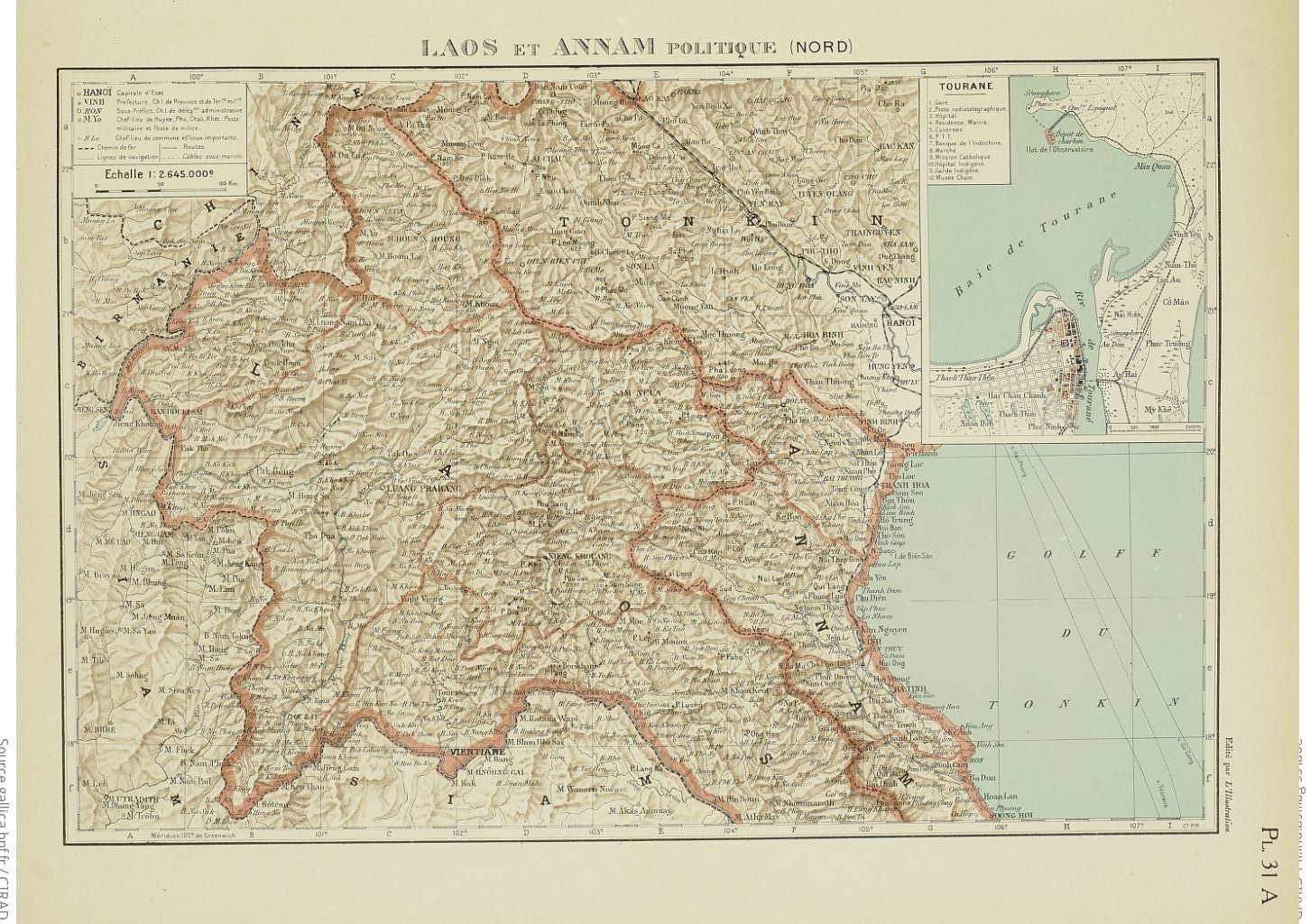 Political map of Laos and northern Vietnam in the 1930s
In short, Luang Prabang was governed in decidedly peculiar forms, and in some way these oddities allowed it to become a regional centre of medium importance, recognized everywhere. Colonial historiography, however, placed at the centre of its inquiries not the plasticity of the local political systems but the inherent military and bureaucratic weakness of the central Mekong kingdoms. The political-administrative structures encountered were for the most part described as the result of processes of imitation and assimilation (for further details see Lieberman). Every innovative impulse—economic-cultural as much as political and organizational—was considered marginal and, in any case, unstable. The substantial orality of the populations and their scant recourse to sophisticated systems for collecting information that might protect the state archives from natural mishaps as much as from sackings certainly contributed to confirming this general intellectual atmosphere; and, as in many other parts of the world, the absence of an indigenous written history seemed to confirm the existence of political systems that were fragmentary and incapable of building a coherent and lasting image of themselves (on this see Lorillard). Indochina—the name given by the French government to the protectorates it had conquered in present-day Laos, Cambodia and Vietnam at the end of the 1800s—represents well this “colonialist” idea of a “weak” place, definable in the encounter of millennial cultures, China and India, but without any capacity of its own to influence the political and commercial trajectories of the epoch.
The arrival of the French in Laos also seems paradigmatic of a salvific vision of the Colony. In the texts of those years one can read, for example, that the “Colony” had pacified lands otherwise marked by chaos and feuds that often reached the complete annihilation of political adversaries; or that “the white man,” the “falang,” had brought back security to cities that were periodically sacked by bands of raiders and bandits; or again that it had built and perfected the routes of communication and permitted a renewed growth of trade. The “Colony,” in other words, “brought peace and well-being,” but in doing so it essentially reduced the variety of the political entities that existed along the region's principal rivers, subjecting them to a well-defined and hierarchized order, at the apex of which stood the bureaucratic-military structures and the commercial enterprises generally managed by a scanty group of falang. The account of the encounter that would bind the royal family of Luang Prabang indissolubly to the French government describes this intellectual atmosphere in an almost paradigmatic way.
The Vice-Consul, Auguste Pavie, in colonial historiography would in fact have played an essential role in saving King Oun Kham, in 1887, from a “band of Chinese raiders” who bore the name of the army of the “Black Flags” and at whose command sat “a Chinese warlord,” Deo Van Tri. Following, then, the colonial narrative, the band entered Luang Prabang destroying much of the city's architectural structures, but the King was saved by a boat that had been prepared for him by Pavie himself, in order to take him to a city further south, to Paklay, still on the Mekong but more than 200 km away. As a result of this heroic act, the French were granted the right to substitute themselves for the kingdom of Siam as “protectors” of the kingdom of Luang Prabang; and, even though the new protectorate was not recognized by other Lao kingdoms—above all by the Kingdom of Xiengkhuang—at least until the end of the 1930s the French constituted a new nation subject to the royal family of Luang Prabang, that is, of their most faithful allies.
More recent studies (see here and here) have instead shown that there may be other perspectives on those events. In Lao historiography, the era of anarchy and banditry that the French encountered is generically called the “Ho Wars,” that is, a series of revolts, civil wars and sackings that arose in the north of the country following large-scale migratory processes that occurred in China in the second half of the 1800s. They therefore concern a generic Other, the Ho, who were populations of Chinese origin but with very different histories and provenances among themselves. For this reason the term “Ho Wars” tends to represent, from the “Lao” point of view, a series of profound economic and demographic upheavals that were set in motion in China and were due both to the colonial encounter (the spread of Christianity and trade with England and France) and to the local rebellions against the Qing imperial bureaucracies. In the states of southern and southeastern China, over the course of some thirty years, from 1839 to 1873, more than 30 million people died. That number—undoubtedly an underestimate—is calculated by summing the dead of the two Opium Wars against England (1839–42 and 1856–60), the Taiping Rebellion (1849–61), the war between the Punti and Hakka clans (1855–68), and the Panthay Rebellion (1856–1873). The impact that these events had on the hinterland regions and on the mountains of Vietnam and Laos is still scarcely studied. For this reason the sacking of Luang Prabang of 1887 has been considered a peripheral product of vaster mutations. The colonial narrative considered it a simple manifestation of banditry connected to the era of “anarchy”—that is, to the Ho Wars—that preceded the arrival of the French. In truth the story was decidedly more complex.
What we know today about the sacking of Luang Prabang is that, in 1887, the Band of the Black Flags had not existed for at least five years, and according to some historians it was impossible to consider them a band; rather, they had by then become a military corps of the Vietnamese imperial army. The definitive fusion with the official army took place during the war of conquest of the Bay of Tonkin by the French (1884–85), but it had already for some time been engaged, on behalf of the imperial administration, in managing various territories around the Red River—that is, along the river route that connected China to Hanoi. Following the Vietnamese defeat, its captain, Liu Yungfu, together with the other members of the Band, dispersed. Some of them took refuge in the mountains of northwestern Vietnam, and this may have misled Pavie and, with him, an entire generation of French historians. What probably confused Pavie was the personal bodyguard of Deo Van Tri, which was in fact composed of soldiers of the Zhuang ethnicity, some of whom came precisely from the Vietnamese military corps and, at a relatively distant time, had been part of the “Black Flags.”
It is interesting to note that before fighting against the French, the band had been part of the variegated army of the Taiping, that is, of a messianic evangelical army that had rebelled against the Qing dynasty and that, in a short time, had managed to bring together a vast world of armed actors who did not belong to the Chinese imperial army. Its supreme commander, Hong Xiuquan, after studying with English missionaries, had come to consider himself a kind of Chinese reincarnation of Jesus Christ. The military commanders gathered in prayer assemblies together with him, during which they spoke with God and defined the military strategies to follow. Their objective, besides liberation from the Qing dynasty, was to create the “Heavenly Kingdom” in China. The notion of the “Heavenly Kingdom” is of extreme importance for understanding the messianic military movements of Southeast Asia that would accompany the colonial construction in the region. But I will write about it better later on. For now, suffice it to say here that the defeat of the Taiping rebellion, together with the death of millions of people, generated migratory movements on a vast scale and unprecedented pressures on the organization of the land. This occurred while the liberalization of opium production imposed by the English generated an equally unprecedented conversion of agricultural fields to the cultivation of the poppy. Within a few years, the poppy and its derivative, opium, became by far the largest production of all of southern China. Obviously the border territories, such as Vietnam and Laos, were also conditioned by this rapid transformation, and it is therefore evident that the macro-category of the “Ho Wars” is still awaiting a better understanding in regional historiography.
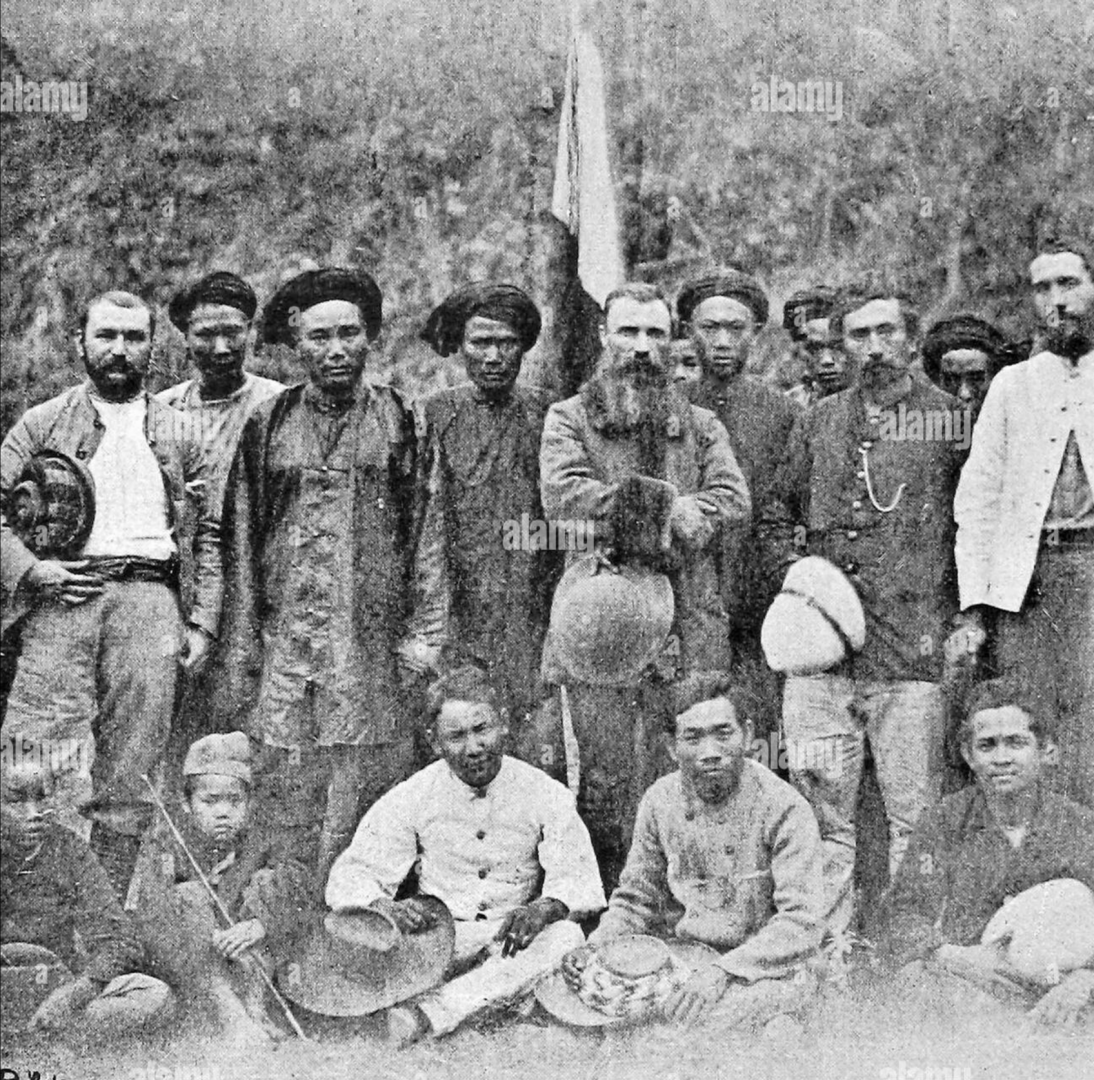 In the photo one can see Deo Van Tri beside Auguste Pavie and the Zhuang escort
Returning instead to the sacking of Luang Prabang—having clarified the military and not banditry-based nature of the expedition that struck the city—it is now important to redefine also the narrative about the “Chinese warlord.” Deo Van Tri, though having Chinese descendants (since his father was a Chinese merchant who had married a Tai Dam princess), was himself born in Hanoi and was considered in that epoch a Tai Dam King. He was therefore certainly not a Chinese warlord. Moreover, his political role was, from the very beginning, of fundamental importance for the French colony. The friendship between Deo Van Tri and Pavie, documented for example by the recent work of Le Founnier, is probably one of the closest developed by the Vice-Consul of Luang Prabang during the colonial expedition in “Indochina.” The Deo clan would be so important for the French colony precisely thanks to its ability to control the opium trade in the region. When in 1954 the French were driven out of Vietnam, the son of Deo Van Tri, Deo Van Long, would be transferred together with his whole family to France, to Marseille, where his descendants still live today.
This particular intimacy between the Deo clan and certain emissaries of the colony, however, made more than one person in Luang Prabang turn up their nose—in particular its Viceroy, Phetsharat, who in various memoirs written by himself in the 1940s, and on the basis of direct testimony from people who witnessed the events of 1887, called into question Pavie's role in the sacking of Luang Prabang. In his view, Pavie saved the King not because he was informed of the facts, but because, in some way, it had been he himself who created the conditions for them. To avoid complicating the story any further, suffice it to say here that before the sacking of Luang Prabang, the army of Siam had begun a large-scale military operation, supported by the English. The objective was to consolidate control of the central Mekong and of some of its principal tributaries, such as the Nam Ou, in order to better manage the distribution of opium and, at the same time, to create a buffer zone beyond which the migrations of those years were not to push. Luang Prabang was used as a base of support for the military expedition that ascended the Ou River to reach the regions of Lao Cai, of which Deo Van Tri, together with his father, was the lord by dynastic right, after the marriages with the princesses mentioned above. Here, after several months of war and after taking prisoner at least 5 members of Deo Van Tri's family, the army of Siam withdrew and returned towards Bangkok. To hear the Viceroy Phetsharat tell it, Pavie would have suggested to Deo Van Tri that the kidnapped relatives were located precisely in Luang Prabang—a city Deo Van Tri knew very well, because as an adolescent his father had wanted him to study there, in one of its principal temples. It is no coincidence that those killed by Deo Van Tri were not all the citizens moving along the streets, but precisely the people who had betrayed him, that is, those closest to him in the city, such as the then-Viceroy Souvhanna Poumma, guilty of not having warned him in time of the imminent danger.
The reconstruction of other historiographical perspectives on this affair allows us to propose some conclusions general enough not to constitute a forcing of the available historical evidence. First of all, more than a group of bandits, the sacking of Luang Prabang concerned a genuine military expedition whose objective was to punish the city's high political offices for their betrayal and for the support they had provided to the army of Siam. Second, the killing of the allies of Lao Cai produced an irreparable rupture that did not allow the restoration of the status quo in which Luang Prabang had been accustomed to maintaining relations both with Bangkok and with Lao Cai. However, instead of bringing it closer to Siam, it allowed an easier French settlement. That is, the division produced the most classic of “divide et impera.” By disconnecting from one another the mountainous areas of the north and the ties that had always existed between the Ou River and the Black River, the French were able to manage with ease the proceeds of the opium trade of that region without having to share them with intermediaries too powerful—apart from the Deo clan on the Black River, and the royal family of Luang Prabang on the Nam Ou.
The ones penalized above all were the populations who devoted themselves to poppy production, namely the Hmong, who—though attempting repeatedly to rebel against the new commercial agreements and the lower sale prices—found themselves divided between the two zones of influence created by the French (see Mai Na Lee). This in fact prevented the Hmong leaders from establishing themselves as reference intermediaries in the distribution of the “oil of the epoch,” opium, and this was true at least until the arrival of the CIA. Third, the strategic necessity of “cutting” the commercial and political relations of these two geographical areas represents a constant of the whole colonial epoch but also of the two Indochina Wars. The events of Dien Bien Phu of 1954 could demonstrate this quite clearly, but this is not the aim of the text. Suffice it now to underline that the frontiers between the two regions had a direct impact on the control of the central Mekong, because they did not permit the creation of potentates sufficiently ambitious and autonomous with respect to the powers allied with the colonial forces. In other words, the flows of the galactic polities were blocked to the advantage of the French.
Fourth, Pavie's “little” lie had a vast impact on the official historiography of the Colony. On this point I would like to spend a few more words. Thanks to the events of 1887, all the French texts of the colonial epoch sustain a basic idea that is very important for the legitimacy of the Paris administration's conduct: that it was substantially well accepted by the local population. It may be, then, that we find ourselves in an anthropological condition of the “Captain Cook” kind, made famous by a totem of post-colonial anthropology such as Marshal Sahlins. However, from this benevolence there derived a long series of other historiographical hypotheses that not only ideologically sustained the Colony but also produced the legal and political bases of the subsequent French military interventions in the region. For this reason we must now make a small leap forward to the Second World War in order to retrace some still-open questions of the colonial encounter.
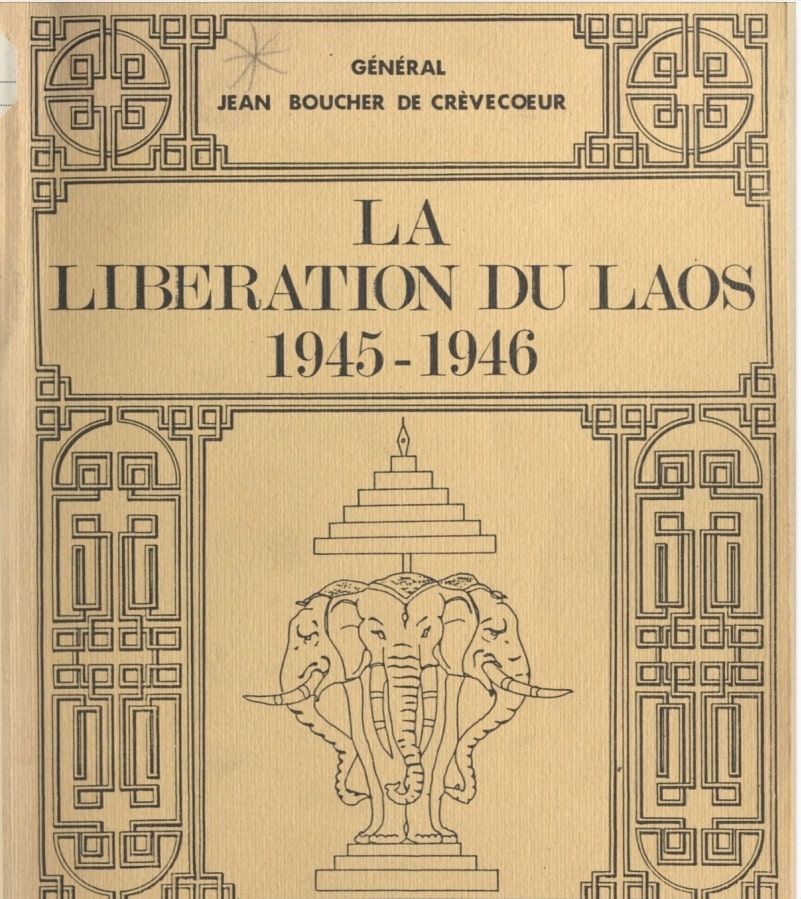 Cover of a text (1985) of military propaganda during the Cold War in Laos
In extreme synthesis: if the local populations were happy with the French, and the chronicles of the epoch struggled to find episodes of revolt and rebellion even in the most remote zones of the country, why did an anti-French movement form? Lao nationalism and the anti-French sentiments of the 1930s, which organized themselves into the (also armed) movement of the Lao Issara, were reduced by the colonial administration to an elitist political project that found scant diffusion among the population. In those years, at the apex of the movement stood the Vice-King of Luang Prabang, Phetsarat. It is no coincidence that his office was abolished by the colonial administration. By then it had only symbolic value in the city, but not “national” value. The Vice-King, in fact, in the event of the King's death, would have become his dynastic successor. There was, that is, a system of transmission of power that followed lines of blood kinship that were also horizontal, and not only by filiation. Among the members of the Lao Issara there was also the “Red” Prince, born of the fateful love between Phetsarat's father and a cleaning lady of his residence, Souvanuphong, great friend of Ho Chi Minh. The contest between the two factions emerged in all its drama when, on 12 October 1945—a symbolic date of worldwide indigenism—Phetsarat, as Prime Minister, declared the independence of Laos from France. King Sisavangvong did not ratify it; indeed, he issued an arrest warrant for Phetsarat and Souvanpong as traitors to the monarchy. The two would remain in prison for a very short time, since the guards let them escape towards Thailand. Here, together with other exponents of the Lao Issara, they began to organize the armed resistance against the French and against the royal family of Luang Prabang. In a few weeks they reconquered from the French two important cities of the centre-south of the country, Takhek and Savannakhet. Here, together with some remnants of the occupying Japanese army and with Vietnamese volunteers, they built barricades to defend the cities from the reprisals of the French army, which in the meantime had emerged from the German sphere of influence and had received weapons and provisions from the English.
According to various texts of French military history taken up in the already-cited book by Mai Na Lee, the anti-French and “anti-white-man” alliances that the Lao Issara produced—in particular with the remnants of the occupying Japanese forces and with the armed group of Ho Chi Minh's Vietminh—provided the French and Hmong mercenaries with the “historic” mandate to bring war against Nazi-fascism in Laos as well. In other words, the military campaigns of 1945–46, in which they committed a still-imprecise number of massacres, went down in history as actions ascribable to the global campaign against National Socialism and as actions for the “liberation of Laos.” Among these actions the most important was the massacre of Takhek, where in a few hours the Franco-English air force exterminated several thousand people who, never having seen aircraft before, thought they could find refuge in the Mekong, becoming instead an easy target. The French General Jean Boucher de Crevecoeur—who would hold important military roles even at the European level up through the 1980s, and who was commander of that specific expedition—would define the massacre as a fundamental victory against Nazi-fascism. The massacre of Takhek, which took place on 21 March 1946, is today considered instead by the historians of the Lao Communist Party as the event that began the First Indochina War in Laos and decisively marked the support of the Lao populations for the guerrilla movements. What matters, however, by way of conclusion for the purposes of this writing, is that in the colonial narrative the French gendarmerie arrived on these lands first as a saviour and then as a liberator, at least until 1954, when it was finally driven out.
Furthermore, it must be clarified that in Laos there was first of all a long civil war that began on 12 October 1945 and concluded on 3 December 1975 with the birth of the People's Republic of Laos. Immediately afterwards, a phase of “social cleansing” began that would not produce a genocide as in Pol Pot's Cambodia, but would generate a vast flow of people expelled and exiled from the country—all those who were considered collaborators of the CIA and of the monarchy of Luang Prabang. The old capital of the kingdom of Lan Xang, in a few years, became “a ghost city,” as a French UNESCO urban planner defined it when he was able to enter it at the beginning of the 1990s. Alongside the abandonment of some zones of the country, countless others had been completely razed to the ground. Of cities and monuments there remained nothing but rubble throughout the Kingdom of Xiengkhuang. The same was happening in the centre-south of Laos. The reconstruction, however, did not benefit from any foreign funds or capital. The allies China and Vietnam were not doing very well themselves, and the USSR had already entered its declining trajectory, having to sustain an oversized military apparatus. Apart from rice and little else, the allies of the newborn People's Republic could not prevent a tragic famine due perhaps more to the mines and unexploded bombs scattered among the rice paddies of the river valleys than to the collectivization of the land, which in any case lasted only five years. The one who managed this phase of expulsions and reconstruction of the country—extremely complex and painful—was the commander of the Lao Liberation Army, Kaysone Phomvihane, born in Savannakhet to a Vietnamese translator and a Lao peasant woman. Kaysone had participated from the very first hours in the anti-French uprisings and in the Lao Issara, and his story is by now another legend of the country.
The Kaysone Exception
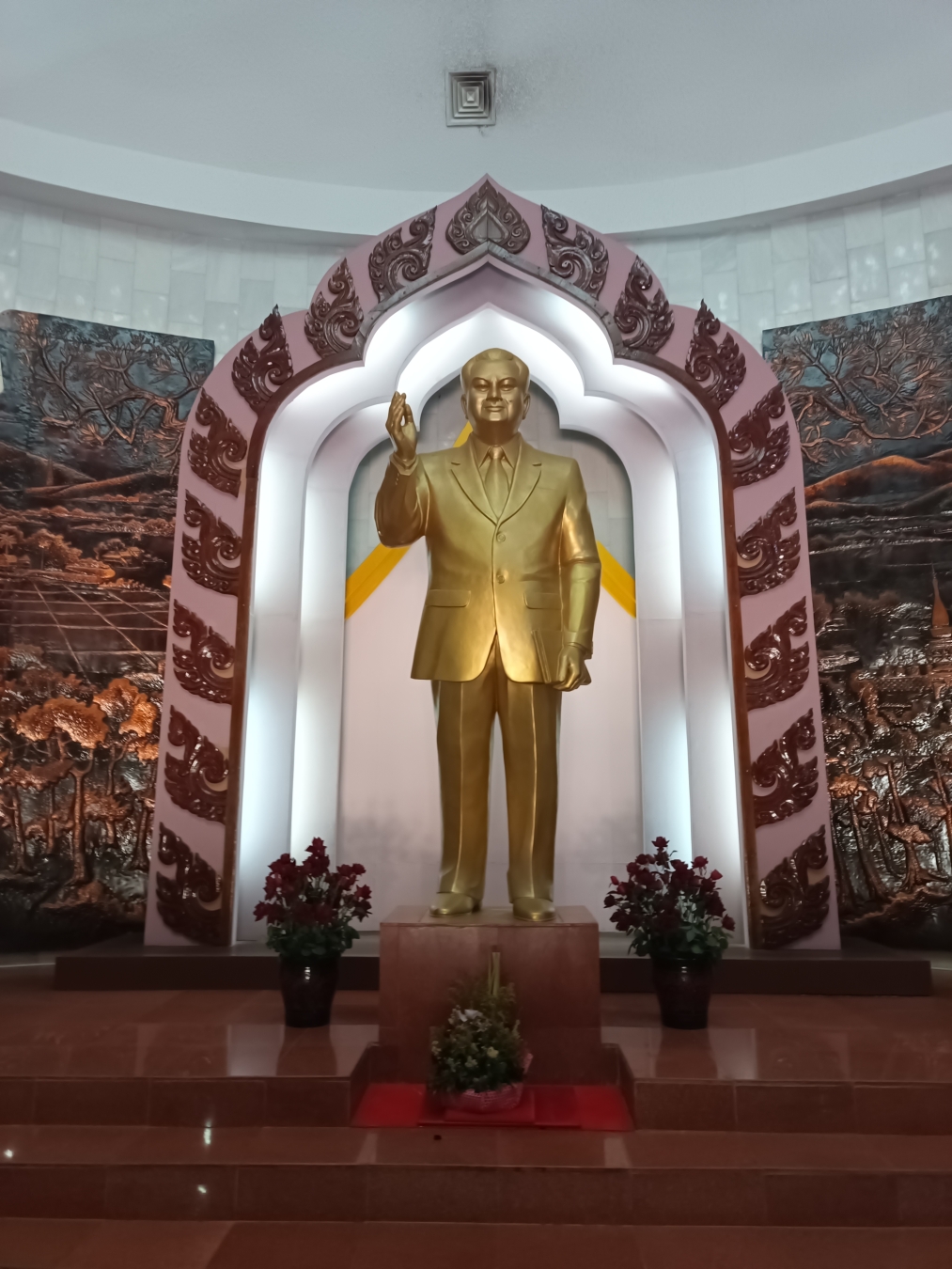 Statue of Kaysone Phomvihane displayed in the Museum dedicated to him on the wars of liberation of Laos, Vientiane, Laos
Today, for those who follow more markedly nationalist positions nostalgic for the monarchic period, the commander of the Lao Liberation Army is considered a Vietnamese and not a Lao. This assertion has a twofold valence. For some—the more radicalized ones—Kaysone would be a usurper of the power of the Lao who did not respect the peace agreements and seized power through a coup d'état. This came about by virtue of an “external” political will, due to the Communist International and not to a collegial decision taken by the National Assembly. Certainly these people do not see Kaysone as a hero who, together with a few others and for most of his life, fought for the conquest of the political independence of Laos. Indeed, they hold him to be the architect of its subjugation to communism. This position has been repeated to me many times, entirely informally, by more radical exponents of the movement for democracy in Laos, that is, by those who would like to establish in the country a constitutional monarchy on the Thai model.
There is, however, also a second and more sophisticated explanation of the old guerrilla commander's impurity. Kaysone's father was in fact a Vietnamese who came to Savannakhet together with the French and dealt, on their behalf, with the administration and bureaucracy of the city. During the colonial epoch, several thousand Vietnamese migrated to Laos by the express will of the French. I have no elements to define them as deportations, but some, in the centre-south of the country, remember them that way. Their labour contributed substantially to building most of the arteries of communication and the colonial residences of the centre and south of Laos. Kaysone's father, however, married a Lao woman of humble origins from a village near Savannakhet. He was also deeply Buddhist, and Kaysone, from a young age, was made to be educated in a monastery, living as a novice until the age of 16. Then his father wanted him to continue his studies in Vietnam, and he lived for some years in Hanoi. Compared to the preceding stories and to the royal dynasties, Kaysone's biography appears from the outset an exception.
It is the story of a Lao like so many others, whose descent—his “Lao” blood—is inherited not from the father but from the mother. Moreover, he does not study in the French colonial schools but in a monastery, and he is a devout father and a husband in love with his one and only wife, far from any form of concubinage. Even the photos that portray him, once Prime Minister of Laos, immortalize him in a modest dwelling, with the ever-present ping-pong table and in popular dress, never intent on flaunting the power he had attained. Everything is very far from the aesthetics of regal power that had marked the monarchy, especially after the arrival of the French. Indeed, a person like him could hardly ever have entered the highest spheres of the noble power of Luang Prabang and Vientiane. And it is precisely this coming from “outside the Kingdom” that makes him, in the eyes of the monarchist nationalists, a “Vietnamese” and not a “Lao”—a condition of impurity today shared by many people who are the children of relationships between “falang” and Lao women.
I would like, then, to point out that we are not dealing with a cult of the leader typical of totalitarian governments, as the Museum of the resistance dedicated to him is often hastily analysed. We are instead within a break with the colonial past in which the country is recounted from other points of view, overturning precisely that cult which historically concerned the Kings-Buddha. The story of Kaysone proposes a new Lao-ness because it is popular, ascetic and charismatic—because his patriotic love is born not of the will to power within a royal palace, but among the barricades of Savannakhet and then those of Takhek, in his having lived 10 years in a monastery and 10 years of war inside a cave, together with another 30,000 people in the secret city of Viengxai. His is therefore a story of rebellion that retraces a Buddhist path. More than a personalistic cult, the portrait proposed takes on the valences of an example to follow, and reminds the new generations of the Communist Party—not always attentive to the teachings of History—of the central elements of being a guerrilla, embodied by Kaysone.
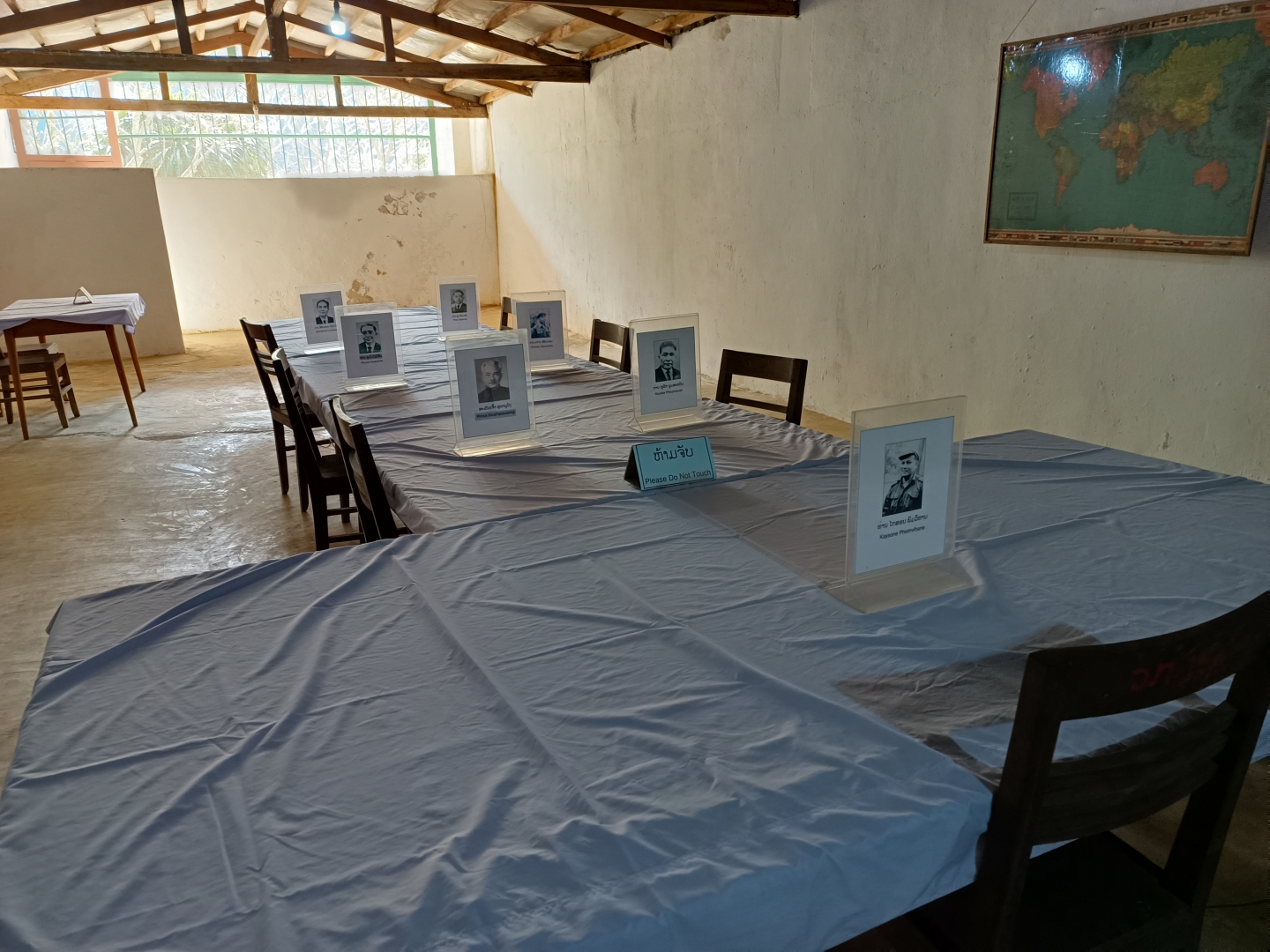 Clandestine Central Committee of the Lao Liberation Army, Vienxay, Huaphan District, Laos
Wishing, however, to try to go further and investigating still more deeply, it is possible to bring this account of Kaysone alongside a specific Lao mythical and literary production made up of heroes of the people who, through wisdom matured on the road and during long journeys, succeed in exceptional tasks. These myths tend to be different from the Buddhist or regal ones, above all because of the absence of descent among the protagonists. Some of them are absorbed by Buddhist cosmology. Others live a life of their own and are still, for the most part, oral tales. Among the former, the most famous is certainly that of Sieu Savath, represented in the “Red Chapel” built next to the city's most important monastery, Wat Xieng Thong. It tells the story of a village boy who decides to set off to know the world and, amid trials and adventures, manages to become an adviser to the King, despite being all but uneducated and belonging to no noble house. He will manage to do so precisely thanks to an innate intelligence and capacity to understand the situations in which he found himself.
In the second category of stories and tales, in the area of Luang Prabang in particular, it is possible to outline a further mythological group that tells of original populations who live in the forests and not off agriculture. These populations are sometimes defined by the word “Kha,” a word that over time came to identify non-Lao peoples, often subjected to them or acquired as slaves. In other cases, the legends deal with the world of the nyak, that is, the demons of the forest, defined in this way probably because of the extremely gruesome nature of the rituals they performed. As written earlier, over the course of the centuries their rites were forbidden, erased, or absorbed by the religion of the Kingdom. Taken together, however, these tales might represent reminiscences of the pre-monarchic past, but also a cosmological pacification never completed in the central Mekong. In this perspective the story of Kaysone would be a genuine ontological reversal. It would signal a folding-back of the mythology and of the founding legends of the city onto a popular hero who finally supersedes the monarchic customs.
Without pushing the conclusions too far, the legend of the 12 sisters—ascribable already to the monarchic period but with reminiscences of a historical time that preceded it—insinuates the suspicion that Luang Prabang too has a feminine tutelary spirit. It concerns an “Indigenous Queen,” Nang Kwang Hi, who was a demon of the forest, daughter of the queen of the kingdom of the nyak, Nang Khong Bhali, whose name takes up the word for monkey, khong, in contemporary Lao. The monkey is an animal very present in local mythology. In the Lao version of the Ramayana—an Indian epic poem not by chance linked to the abduction of a woman—in the place of Hanuman, the Hindu monkey-man divinity, the ones who help the heroes (who in the Lao version are two brothers, Phra Lak and Phra Lham) to defeat the Demon Ravana is precisely an army of monkeys. Not only that: in the Lao account the two heroes transform into monkeys after ingesting a poisonous root, and in their journey in search of the demon and the beloved they will give life to many villages along the Mekong. In doing so they will also be able to form the army that will then defeat the demon. In the legend of the 12 sisters, instead, the princess of the Nyak falls in love with the son of the youngest of the 12 sisters, Buddhasen, a Lao popular hero who was very successful among his people thanks to gambling and to cockfights. Both will die of a love that cannot be realized in life and will produce no descendants. At the time of death, however, they will be buried one beside the other. The tomb of Nang Kwang Hi would be the mountain located on the right bank of the Mekong, exactly opposite the city centre, known locally as Phu (mountain) Nang (woman). The tomb of Buddhasen, instead, is the mountain beside it, called Phu Thao (man). Nevertheless, the legend holds that Buddhasen died at the feet of Nang Kwag Hi, but that Indra (the god), seeing in the superiority granted by fate to the woman over the man an unlucky omen for the future kingdom—precisely because the woman was a demon—decided to modify her position, placing her at the feet of the man.
This myth presents several elements of interest, especially if compared with those concerning the noble families of Luang Prabang. First of all, to a dynasty of demons/indigenous people that is interrupted corresponds that of Khoun Bhulom, the totemic progenitor of the royal family, whose son, Khoun Lo, conquered Muang Swa (the original name of Luang Prabang) on behalf of his father. Probably, then, Khun Lo conquered the city precisely from the Kha or Nyak. In the second place, the story of Nang Kwag Hi describes quite clearly the end of a matrilineal order by divine will. We do not know whether this also recounts the mythical codification of Lao blood kinship along the patrilineal line as the “rule of the kingdom.” Moreover, from this myth we cannot necessarily justify the exchange of women as a practice of government. Nor do we know whether and how, in the specificity of Luang Prabang, the Kha became Lao. In this regard, the colonial archives of the various expeditions that followed Pavie's continued to insert the appellation “Kha” to define certain non-Lao populations. In the early 1900s it seems the word had a derogatory value and was used in racist forms against specific persons who lived in a condition of de facto slavery (see on this Schliesinger). In any case, in the tales of the city the two worlds are separate when one of them—the regal and Buddhist one—does not prevail over the other. The account of Kaysone thus seems to insert itself once again onto a mythical world historically subjected or erased. It might then be very interesting to reread the intricate Lao ethnic question starting from this “indigenous” field—defeated but rediscovered in modern Laos—as well as from the dialectic between the Indianized King and the charismatic leaders. In this way we could once again appreciate political systems not necessarily codifiable through the modern categories of political science, and reconsider bonds and relationships that the country's long civil war has, unfortunately, deeply torn apart. I will write about it as soon as possible.