From the Ashes of an Old PC: A Proof of Concept for Understanding AI (Without Being Programmers)
We often hear about Artificial Intelligence as an external force, something enormous that arrives from afar and changes the rules of the game. But what happens if we try to bring it home, right here, into our own house? And what if we tried to understand it not by studying theory books, but by building something concrete with our own hands?
This post is not a technical tutorial. It is the chronicle of an experiment. A Proof of Concept born from the simple curiosity of understanding how AI really works when it stops being a “chatbot” and becomes a practical operator.
Why did I do this experiment?
I wanted to understand two fundamental things:
Does hardware still matter? In an era of infinite cloud, can we still do useful things with old computers lying in a drawer? Can we “talk” to technology without knowing how to program? If AI is truly the future, it should be accessible to everyone, not just software engineers.
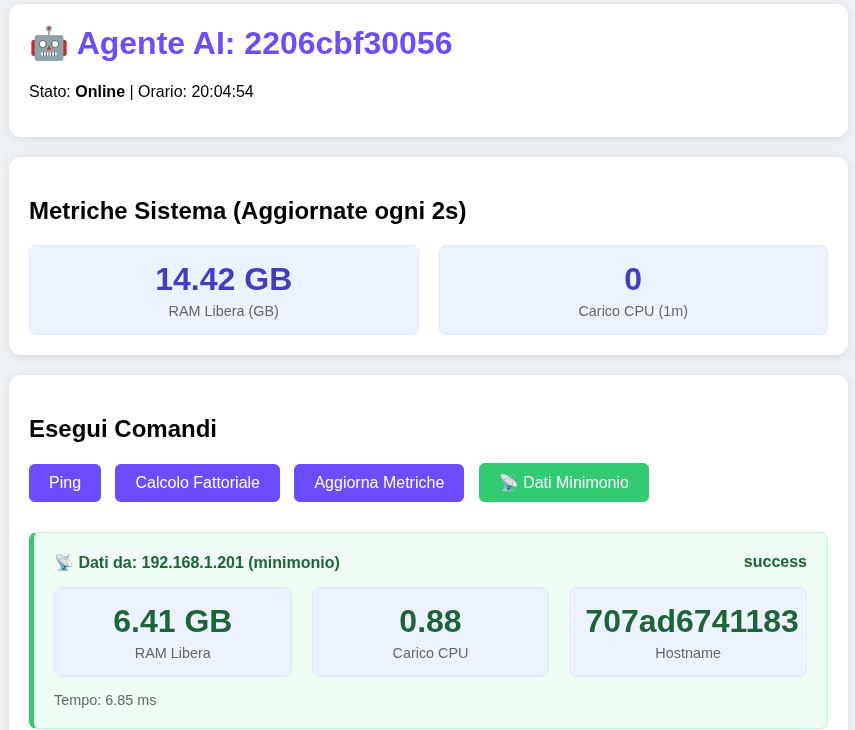
The idea was to turn three heterogeneous devices (two cheap mini-PCs and a laptop) into a network of autonomous agents. I didn't just want to switch them on — I wanted them to talk to each other, monitor each other, and work together. The ultimate goal is to study how AI can manage physical infrastructure in a decentralized way, without depending on distant centralized servers.
The Method: I think, the AI writes
Here comes the most fascinating part. I am not a programmer. I can't write Python code, I don't know Docker by heart, and I don't know how to configure Linux servers.
All the code you'll find in this project, all the configurations, the troubleshooting, and the creation of the graphical dashboard were generated by the AI. My role was that of architect and orchestra conductor:
I defined the goal: “I want these PCs to exchange data and show it to me on a web page.” I described the problem: “The system crashes, I get this error.” The AI translated these requests into working code.
It was an iterative process of trial and error. There were moments of frustration: black screens, containers shutting down on their own, memory errors that seemed insurmountable. But every time, instead of giving up, I used the AI as a technical mentor, asking: “Why did this happen? How do we fix it?” And it answered, explaining the concept behind the error and providing the solution.
This way, I learned to build complex infrastructure without ever manually touching a single line of code. I realized that the value lies not in memorizing syntax, but in knowing what to ask and how to guide the tool.
The Privacy Choice: Why Lumo and Proton
There is a fundamental detail that is often overlooked in these experiments: where does the conversation take place?
I was asking the AI to write code for my home network, to configure servers, and to handle sensitive data. I couldn't allow this information to end up in the training datasets of big corporations or be read by third parties.
For this reason, I chose to use Lumo, the AI assistant developed by Proton.
Proton is known for its mission to protect digital privacy (with encrypted services like Mail and VPN), and Lumo brings this philosophy into the world of AI.
End-to-End Encryption: Everything we exchange is encrypted. Not even Proton can read my conversations or the code I'm generating. No Training on Your Data: My requests, the errors I pasted, and the solutions we found remain private. They are not used to train public models. Independence: Building a decentralized system requires tools that respect data sovereignty from the very first step.
Using Lumo allowed me to run this experiment with peace of mind, knowing that my work, my ideas, and my infrastructure were safe. It's the difference between building a house on rented land or on your own land.
Conclusion: The Beginning of a Journey
This experiment is just the beginning. I demonstrated that it's possible to create a distributed AI agent network using common hardware and guided by artificial intelligence, without needing traditional programming skills.
But the road is long. The next step will be making these agents not just exchange data, but make autonomous decisions based on what they observe. And I will keep doing it with the same principles: curiosity, experimentation, and above all, respect for privacy.
If you too want to start exploring this world, building your own digital infrastructure in total security, I invite you to try Lumo. It's a powerful tool that puts the user at the center, not the data.
Try it and start your journey of discovery: https://pr.tn/ref/31BCQE3B
AI is not magic. It's a tool. And like any tool, its value depends on how we use it and on who builds it alongside us.
Thank you for reading my story.
“Free technology isn't just code — it's the freedom to look under the hood.”
👤 Lorenzo | ItsMeLarry 🧪 AI & Open Source Experiments | 🕹️ Retro Gaming & Graphic Novels 🎸 Rock, Folk, Jazz, Punk | 🔒 Privacy First 📍 Tuscany / Digital