From the Backyard to the Neural Network: How I Built an AI Weather Assistant with Home Hardware
I always thought Artificial Intelligence was something far away, hosted in huge data centers, accessible only through the cloud and expensive subscriptions. But what would happen if we could bring it home? If we could turn old computers into a network of intelligent “agents” that work together, in total privacy and without depending on external servers?
This is not a technical tutorial for engineers. It is the chronicle of a practical experiment: how I turned three old PCs into an intelligent weather and lifestyle system, capable of analyzing my garden and telling me when to exercise, when to rest, and when to enjoy an aperitivo.
And the most surprising part? I didn't write a single line of code.
The Idea: A Proof of Concept for the Future
The goal was clear: to create a Proof of Concept (PoC) of a decentralized architecture. I wanted to demonstrate that it is possible to:
Reuse existing hardware: Turn mini-PCs and old desktops into nodes of an intelligent network. Leverage AI as a co-pilot: Use artificial intelligence to write the code, solve errors, and manage the technical complexity. Maintain data sovereignty: Run everything locally, without sending sensitive information to third parties.
The result is a system that collects data from a real weather station, processes it with a local language model (Ollama), and returns contextualized advice about my specific garden.
The Architecture: Three Nodes, One Brain
I selected three very different devices to test the resilience of the system:
Minimonio: A cheap mini-PC (Intel Celeron, 7GB RAM). The “sensor” node, lightweight and low-power. Thinkmonio: A small desktop (Intel i3, 15GB RAM). The main “agent” node, responsible for the web interface and orchestration. Tuxedo: A powerful laptop (AMD Ryzen, 31GB RAM). The “brain” node, where the local AI model runs.
Each node runs Docker, ensuring the software is isolated and portable. It doesn't matter how old or new the hardware is: the container works the same way everywhere.
The Process: Iteration and Adaptation
The path was not linear. It was a continuous cycle of “try, fail, fix”, guided by dialogue with the AI.
Phase 1: Infrastructure Stabilization
The first obstacle was getting the base nodes to work. Minimonio would shut itself down to save power. The solution? Disable the kernel suspend settings and force the CPU to run in performance mode. A seemingly trivial problem that would have blocked the entire system.
Phase 2: Communication Between Nodes
Once stable, I had to make them talk to each other. I created a simple REST API (using FastAPI) that allows thinkmonio to query minimonio for its system metrics. The result? A web dashboard showing the health status of both computers in real time.
Phase 3: Weather Data Integration
Here the “real” part comes into play. I connected my Raddy WF-100C weather station (which publishes to Weather Underground) to the system. Thinkmonio now downloads current data (temperature, humidity, wind) and forecasts from the Open-Meteo APIs.
Phase 4: Local Intelligence (Ollama)
The decisive step was adding the “brain”. Instead of using cloud services like Groq or ChatGPT, I installed Ollama on tuxedo with the llama3.2 model. I created a structured prompt that provides the AI with:
Current weather data. A detailed map of my garden (Zones A-E, with specific features like the turtle Camilla's terrarium). The task: “Analyze the data and give me practical advice on activities, zoning, and timing.”
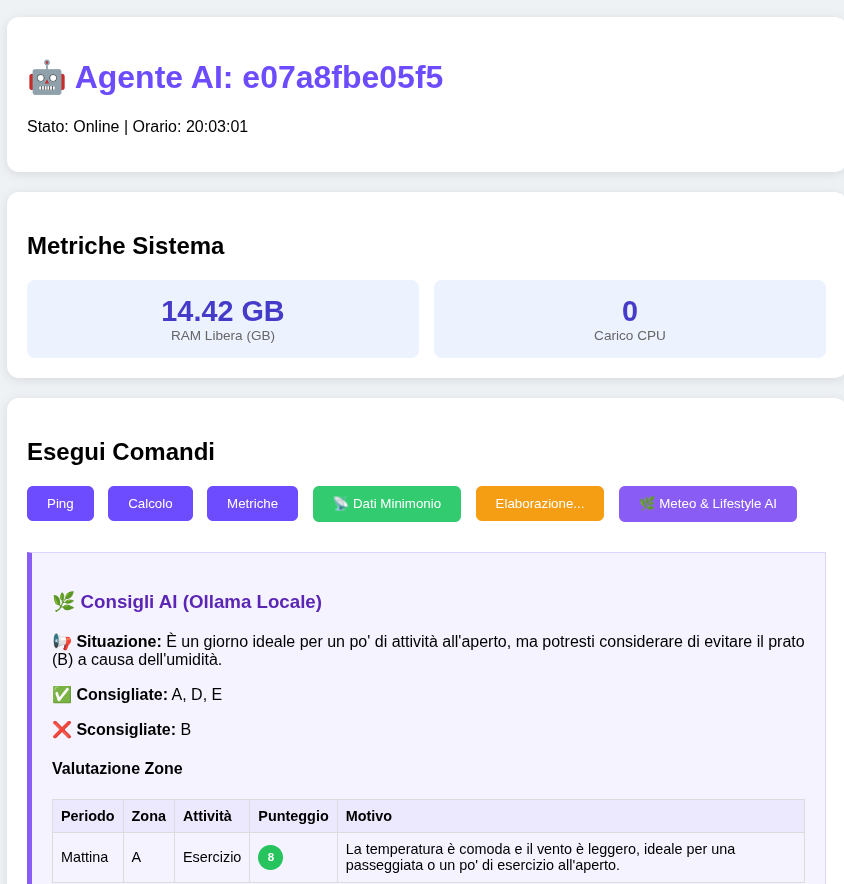
The system now responds with personalized advice: “Avoid the lawn (Zone B) due to high humidity, but Zone A is perfect for morning exercise.”
The Ethical Choice: Privacy by Design
There is a fundamental detail that is often overlooked in these experiments: where is my data processed?
I was handling information about my home, my GPS position, and family habits. I couldn't allow this data to end up in the training datasets of big corporations. For this reason, I chose to use Lumo (by Proton) to design the architecture and Ollama for local execution.
Lumo: It allowed me to discuss the project and generate the code in an end-to-end encrypted environment. No one, not even Proton, can read my conversations. Ollama: Runs the AI model directly on my hardware. The weather data and the garden description never leave my home network.
Building a decentralized system requires tools that respect data sovereignty from the very first step.
Try it and start your journey of discovery: https://pr.tn/ref/31BCQE3B
The Result: A Garden That Talks
Today, opening the dashboard in my browser, I see not just numbers, but contextual advice. I click a button and the AI tells me:
Situation: “It's an ideal day for outdoor activities, but avoid the lawn because of the humidity.” Recommended Activities: Zone A (Parking), Zone D (Pool), Zone E (Barbecue). Assessment: A score from 1 to 10 for each zone and activity (exercise, nap, aperitivo).
It's not magic. It is the result of an iterative process, solved errors, reused hardware, and a conscious choice for privacy.
Conclusion: The Beginning of Something Bigger
This experiment demonstrates that the AI of the future won't live only in centralized clouds. It will be distributed, everywhere, on our own devices.
Resilience: If one node falls, the others keep working. Efficiency: We use existing resources instead of buying new ones. Accessibility: Anyone with a bit of curiosity and an old PC can start building their own intelligent infrastructure.
Technology is not magic. It is a process of attempts, errors, and adaptations. And sometimes, an old mini-PC and a bit of patience are enough to create something extraordinary.
If you want to try to replicate this experiment or have questions about the process, write to me on Mastodon https://mastodon.uno/@itsmelarry
The road is long, but what matters is moving forward — even sitting down!
“Free technology isn't just code — it's the freedom to look under the hood.”
👤 Lorenzo | ItsMeLarry 🧪 AI & Open Source Experiments | 🕹️ Retro Gaming & Graphic Novels 🎸 Rock, Folk, Jazz, Punk | 🔒 Privacy First 📍 Tuscany / Digital