The Day My House Lit Up an AI Datacenter Under My Desk
A ship's log from the home lab, between mini PCs, laptops, and LLMs talking to each other to ask what the weather is like in my backyard.
There are projects born out of necessity and projects born out of curiosity. This one was born from both, with a pinch of wanting to have fun while pushing a few limits.
Disclaimer
I am not a developer, nor a sysadmin. Everything you will read on this blog, I did by asking the AI how to proceed, managing feedback and work with the help of models — in particular Lumo by Proton, which I appreciate because it's an assistant that works very well, costs little, and above all minds its own business. Which, unfortunately, is rare in the digital industry.
Today I can say the first brick is laid. It's not elegant, but it holds.
How the network is made
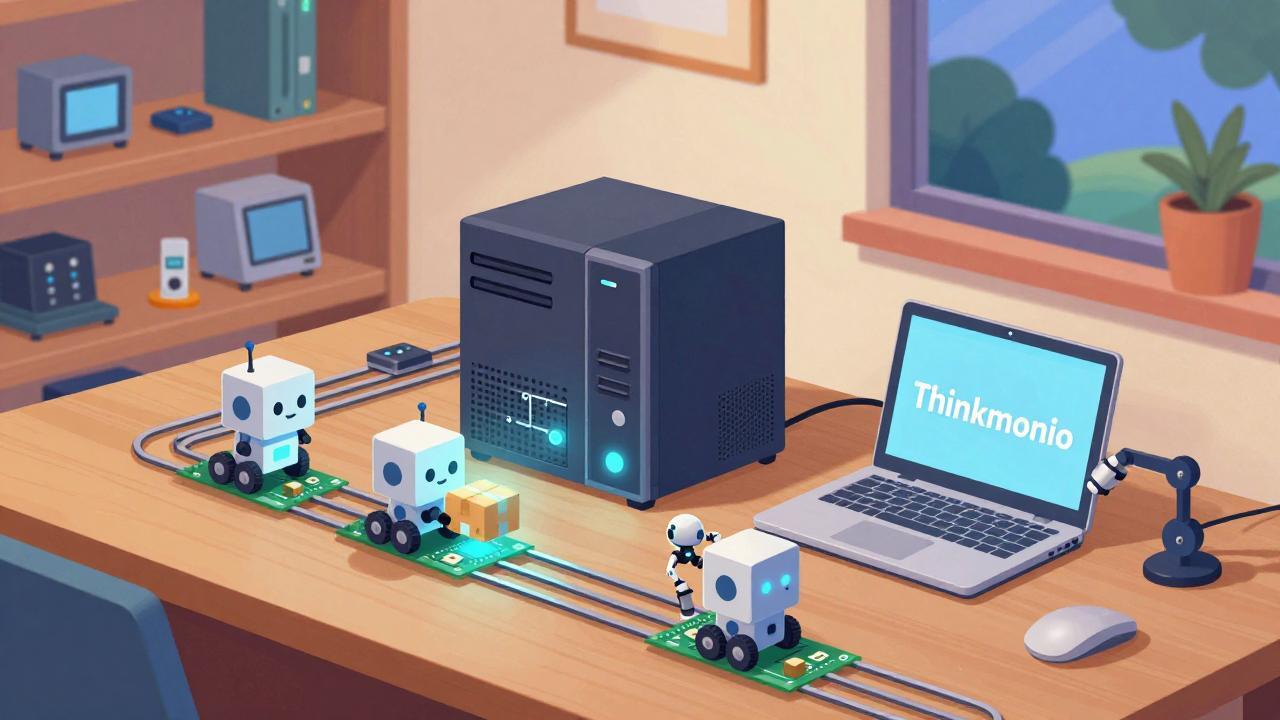
The underlying idea is simple: four machines, individually nothing special, but networked together they become something more interesting than their simple sum.
Geekmonio is the brain. A mini PC with an Intel Core Ultra 9, integrated Arc GPU, and 32 GB of RAM. It's not a datacenter monster, but it has one precious feature: a dedicated NPU and a GPU that, with the right drivers, lends itself to inference acceleration. It hosts Ollama and the web interface, and it's where the heavy lifting happens. I installed Ubuntu Server without a graphical interface to keep RAM consumption to a minimum.
Tuxedo is my laptop with TuxedoOS (Ubuntu-based), the workbench. An AMD Ryzen 7 with Radeon 780M, running VS Code. Local models via Ollama and LM Studio, but most importantly it queries Geekmonio over the LAN as if it were a cloud service. Light editor, remote brain.
Thinkmonio and Minimonio are the worker arms. More modest machines, bought used on Subito.it for 50 euros each, destined for different tasks: collecting data, acting as a bridge to sensors, hosting lightweight agents that don't require local inference. They will be the nodes that, in the not-too-distant future, will do “things” — measure, record, react — on which to build the agents orchestrated by Geekmonio's models.
What actually runs on it
Three models, chosen with care after several attempts and a few dead ends:
Qwen2.5-Coder 7B Use: programming and autocompletion Why: precise on code, fast enough to suggest while you write
Mistral Nemo 12B Use: chat and reasoning Why: huge context, handles Italian well
Llama 3.2 3B Use: quick tasks Why: for things where latency matters more than depth.
All three live on Geekmonio, served via local API. VS Code on Tuxedo reaches them through Continue, the web interface exposes them as a chat, and the smaller nodes query them when needed.
I set up all these configurations with AI assistance, following its instructions. It will be fun to see whether they prove valid or not — this uncertainty is what intrigues me most and pushes me to keep going.
The part that really interests me
The technical setup is secondary. The interesting part is the economic logic behind it.
It would be easier to swipe the card and pay for a “pro” subscription. That's fine for asking for a tomato pasta recipe. But when you start using AI to actually make things, for what it's truly revolutionary for, tokens start flowing and remote models — the smart ones, hosted on servers with tons of RAM and NVIDIA chipsets — end up costing a lot, and I mean a lot.
There is no will to make them accessible on the market's part. The AI industry, led by 4-5 companies, in its pursuit of AGI is pushing toward a monopoly situation where citizens' AI experience will always be mediated by the need for a technological intermediary, with all the ensuing economic, social, and political consequences. The rising price of consumer RAM is just one piece of a worrying puzzle.
My idea is to have an AI I fully control:
- Online assistants like Lumo (I'm eagerly awaiting the APIs) and Leo AI (with no privacy policy) for support: clear policies, great for writing configuration scripts or summarizing complex logs
- Local models for reasoning, code production, and orchestration
- Paid remote models (like Mistral AI) when all of this isn't enough
Choosing what to use, where, and when, while keeping control over data privacy: that's what I want to find out is possible.
That's what the local network is for: absorbing low-value tasks. Repetitive work, small reasoning, drafts, routine questions. Everything that doesn't deserve a frontier model's attention gets handled at home, for free, offline, without burning credits.
Remote models thus become what they should be: a scarce resource to use when it really counts. Difficult decisions, new problems, things that require true intelligence.
What's still missing
I'd be dishonest if I said everything is fine. Autocompletion is sometimes slow, configuring Continue gave me more trouble than expected (in the end I had Copilot solve it), and the integrated GPU has limits you can feel when the context grows long.
But the structure is there. The pieces communicate. The system holds. Performance needs polishing, and that can only be done by using it.
Where this all leads
The final goal is not to have a chatbot at home. It's to build an infrastructure that knows how to route the work: trivial tasks locally, important ones remotely, autonomous agents for the things nobody wants to do by hand.
It's an experiment, in the most honest sense of the term. I don't yet know if it will work the way I imagine. But the first step is taken, and this time the terminal didn't throw errors back at me.
Next chapter
Building a software factory that produces the software agents I need. I want to be able to build myself the infrastructure I'll use at home, so the next chapter will be creating a first agent to install on Thinkmonio.
“Free technology isn't just code — it's the freedom to look under the hood.”
👤 Lorenzo | ItsMeLarry 🧪 AI & Open Source Experiments | 🕹️ Retro Gaming & Graphic Novels 🎸 Rock, Folk, Jazz, Punk | 🔒 Privacy First 📍 Tuscany / Digital