Savage Cosmologies
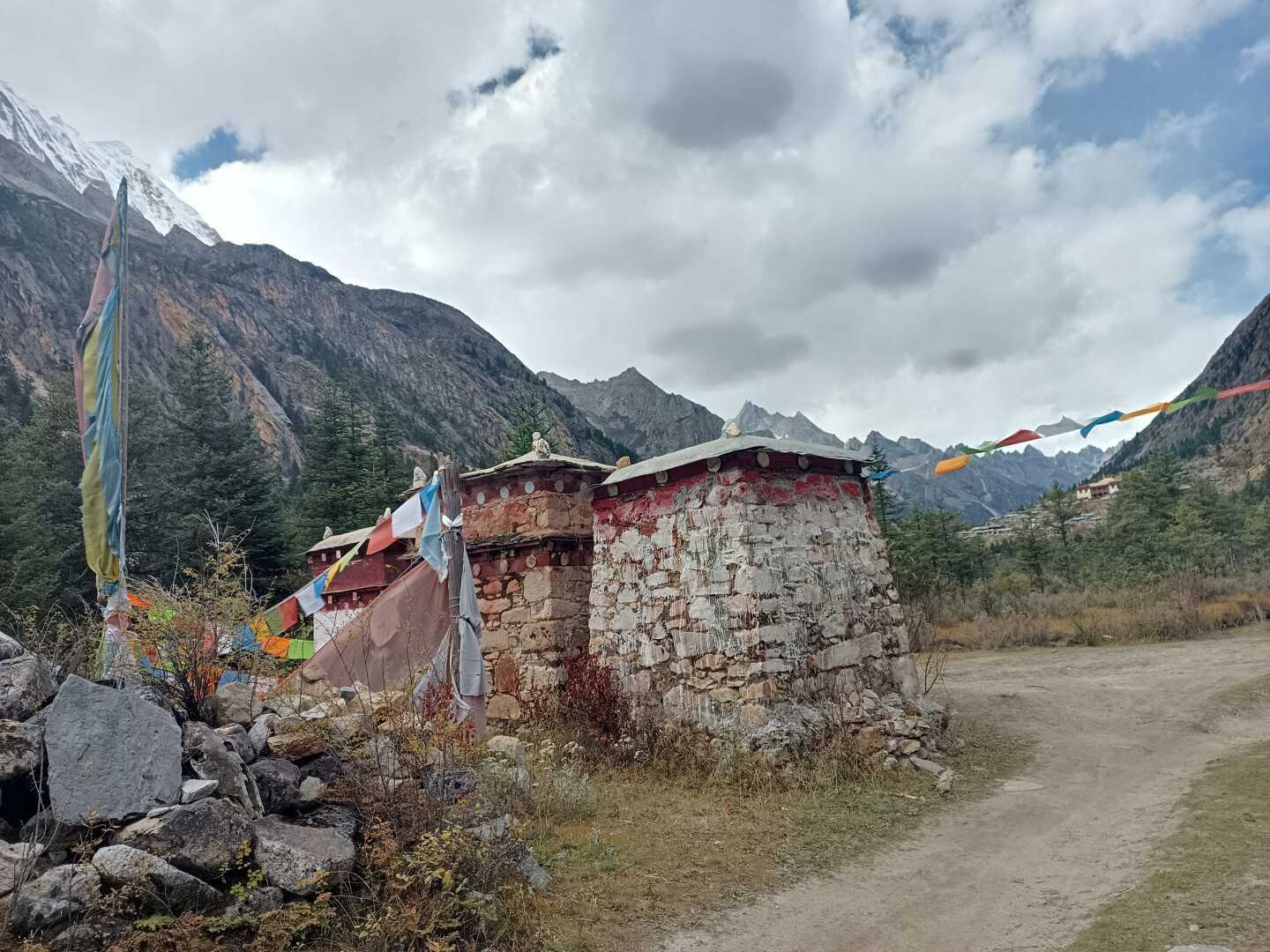 FIG.1 Lenggu Monastery, on the sacred mountain of Ge Nyen, Litang prefecture, Sichuan. Local tradition ties it to Dusum Khyenpa, the first Karmapa (1110–1193) and founder of the Karma Kagyu school, whose principal seat was nevertheless later moved to Tsurphu, some 70 km from Lhasa.
At more than 4,000 metres above sea level, in the ancient region of K’am (eastern Tibet), Lenggu Monastery survives today as an enigmatic remnant. Founded in 1164 by the first Karmapa, Dusum Khyenpa, it was almost entirely razed by the People's Liberation Army in the 1950s. Restored after 2000, it is today tended by just two monks. During a pilgrimage undertaken in late 2025, I attended an annual ceremony in which Buddhism and shamanism appeared to merge. Before the inhabitants of the surrounding villages, the ancient tale of a cosmic contest between tantric deities was enacted. Through the lamas' prayers, music and dances, and a final, cathartic bonfire, the deities agreed to remain within the monastery, acknowledging its pacifying function and turning an ancestral conflict into an occasion for doctrinal debate and meditative practice. That experience — a place of worship set amid the mysticism of mountains held sacred for millennia, becoming the stage for a struggle at once spiritual and political — prompted a broader question: what happens when a revolutionary, progressive and avowedly secular power encounters spaces whose sacredness has historically shaped identities and the very forms of the political? To answer it, I propose a comparison between two seemingly distant contexts — Laos and Tibet — bound nonetheless by an analogous condition: in both, revolutionary praxis did not abolish the pre-existing sacredness but folded it into a new nationalist narrative, one that seeks at once to pacify a contested past and to generate wealth through forms of religious and memorial capitalism. By “religious and memorial capitalism” I mean the process whereby spiritual and historical heritage is turned into a symbolic and economic resource within a system for the production of value.
Guerrilla Sacredness
In the earlier essay I retraced roughly a century of Lao history, aiming to offer a few decolonising points of departure and asking whether Lao resistance had not produced a political-narrative mysticism of its own. To that end I explored the legend of the guerrilla leader Kaysone Phomvihane and the account offered by the Museum of the Resistances, which enshrines him as “father of the nation” of a socialist Laos where Buddhism is not abolished but woven into nationalist doctrine. I read Kaysone's biography anthropologically, in order to show how his figure carried meanings well beyond those of the “war leader”: it marked the passage from the patrilineality of the Lao royal dynasties to a social matrilineality consonant with the kinship practices of the Lao and Tai peoples (Evans 1998; Stuart-Fox 1997). My aim was to connect the pre-colonial political systems — able to adapt supplely to a “conscious weakness” in the face of the numerical and technological might of neighbouring empires — to the political atmospheres that followed the monarchy's fall. The Museum of the Resistances seems intent on reclaiming popular traditions, reconstructing the very essence of the hero: one who no longer springs from a mythical or sacred lineage but is forged by the collective effort of the liberation struggle. The revolution, in other words, appears to fashion a new figure of the people — no longer the lord of life, the chao sivit, who inherited honours and riches from his father; nor the saksit, the man endowed with magical powers, as was Phetsarath, viceroy of Luang Prabang and the country's first anti-colonial leader; nor the chao fa, the messianic war leader descended from the celestial kingdom, as was Vang Pao, general of the CIA and of the royalist army — but rather the ascetic charisma of the sahai (literally “comrade”), tempered on the many battlefields of Laos across more than thirty years of war.
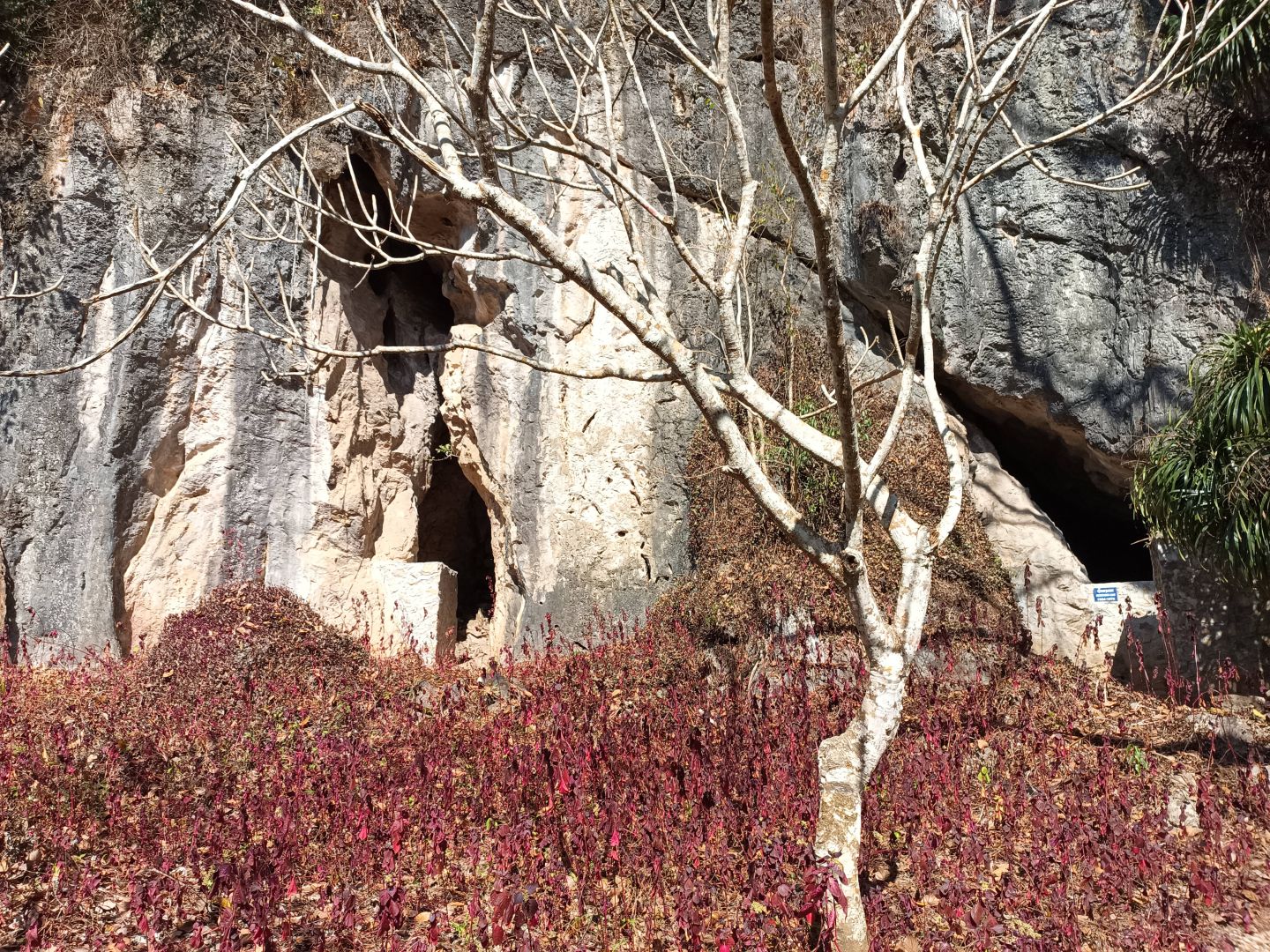 FIG.2 The entrance to Kaysone Phomvihane's cave-refuge at Vieng Xai. Guerrilla asceticism turns the subterranean space into a political hermitage, the wellspring of a charisma that resonates with the ascetic path of Theravada Buddhism.
The apex of this symbolic construction is the cave complex of Vieng Xai, in Houaphan province (Fig. 2). Between 1964 and 1975, more than 30,000 people sheltered there to survive the American bombing; here Kaysone and the Pathet Lao cadres ran a parallel government under conditions of extreme precariousness. Today the caves are a shrine of local history, one that recounts communal life: from enforced withdrawal from the world, to the discipline needed to survive, to the practice of resistance itself. To live at Vieng Xai was to fight both Māra — the ignorance and temptation that, in the Buddhist tale, seek to turn the Buddha from enlightenment — and the bombing and the military invasion. From these shared memories the hybrid figure of Kaysone the ascetic-warrior is born, his cave faithfully reproduced within the Museum of the Resistances; thence, thanks to his monastic education, he is presented as one able to lead his people not by force but by moral example and the plainness of his life.
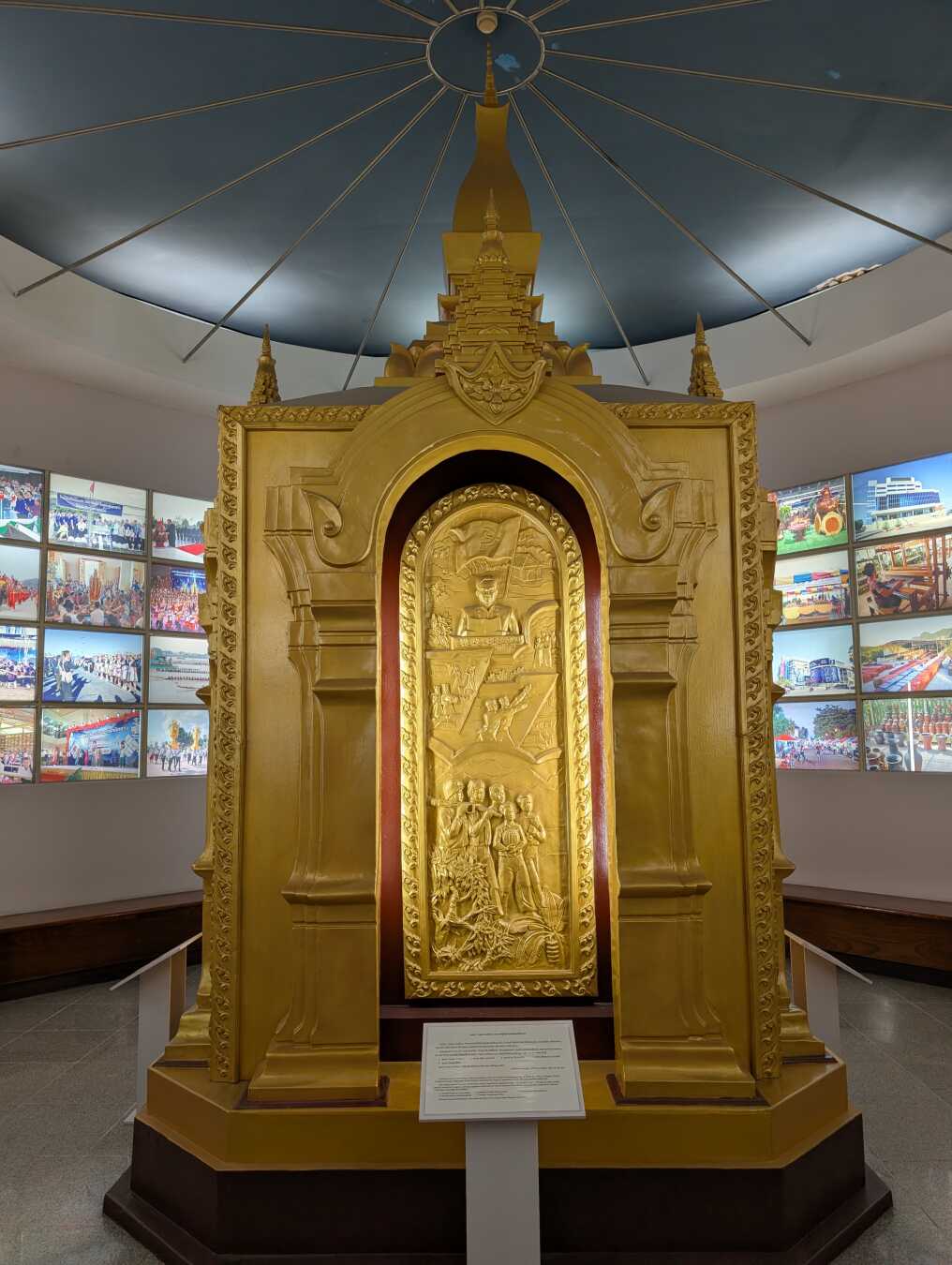 FIG.3 The That Luang installation at the Museum of the Resistances, Vientiane. Buddhist cosmology is repurposed as symbolic scaffolding for the revolutionary project: peasants, schools and power stations take the place of the Jātakas and the royal court.
At the centre of one of the Museum's halls in Vientiane stands one of its most striking installations, which seems designed to carry the mystique of the Vieng Xai mountains into the capital and its state institutions. It is a stylised reproduction of the That Luang — the great stupa raised in 1566 by King Setthathirath, emblem of the kingdom's cosmic order — its base peopled with scenes of partisan struggle, dam-building and rural literacy campaigns (Fig. 3). The stupa, which in the Theravada tradition figures Mount Meru and the universe ordered by the dhamma, is here filled with the substance of the revolution: socialist modernisation supplants the Buddhist monarch as guarantor of the moral order, in a further hybridisation of the sacred and the political. Perhaps the most innovative aspect of this epistemological reversal is that, within Marxism, revolution is always also to be understood as a state of consciousness. Here consciousness remains within Buddhist precepts, yet — as Che Guevara observed in his essay on guerrilla warfare (1960) — it bears on the understanding of the material bonds of oppression as much as on the moral and ethical qualities of the guerrilla, whose aspiration is to embody and reproduce the very liberation that is to be generated out of the communal relations in which he or she is embedded. Theory and practice, in Marxism as in Buddhism, are inseparably bound. Revolution — understood as the education of the countryside, technical progress for all, and the abandonment of royal patriarchy — is not merely a political-economic structure meant to replace the old order; it also asserts the necessity of a new communal way of living if it is to be fully realised. In a country like Laos, this cannot occur without acknowledging Buddhist cosmology, which must nonetheless be prised away from the historical process by which the regional monarchies captured its teachings. In this sense cognitive warfare, the governance of information and thus the conscientization of the population constituted a battlefield of their own during the two Indochina wars. The Museum's sculpture makes this plain.
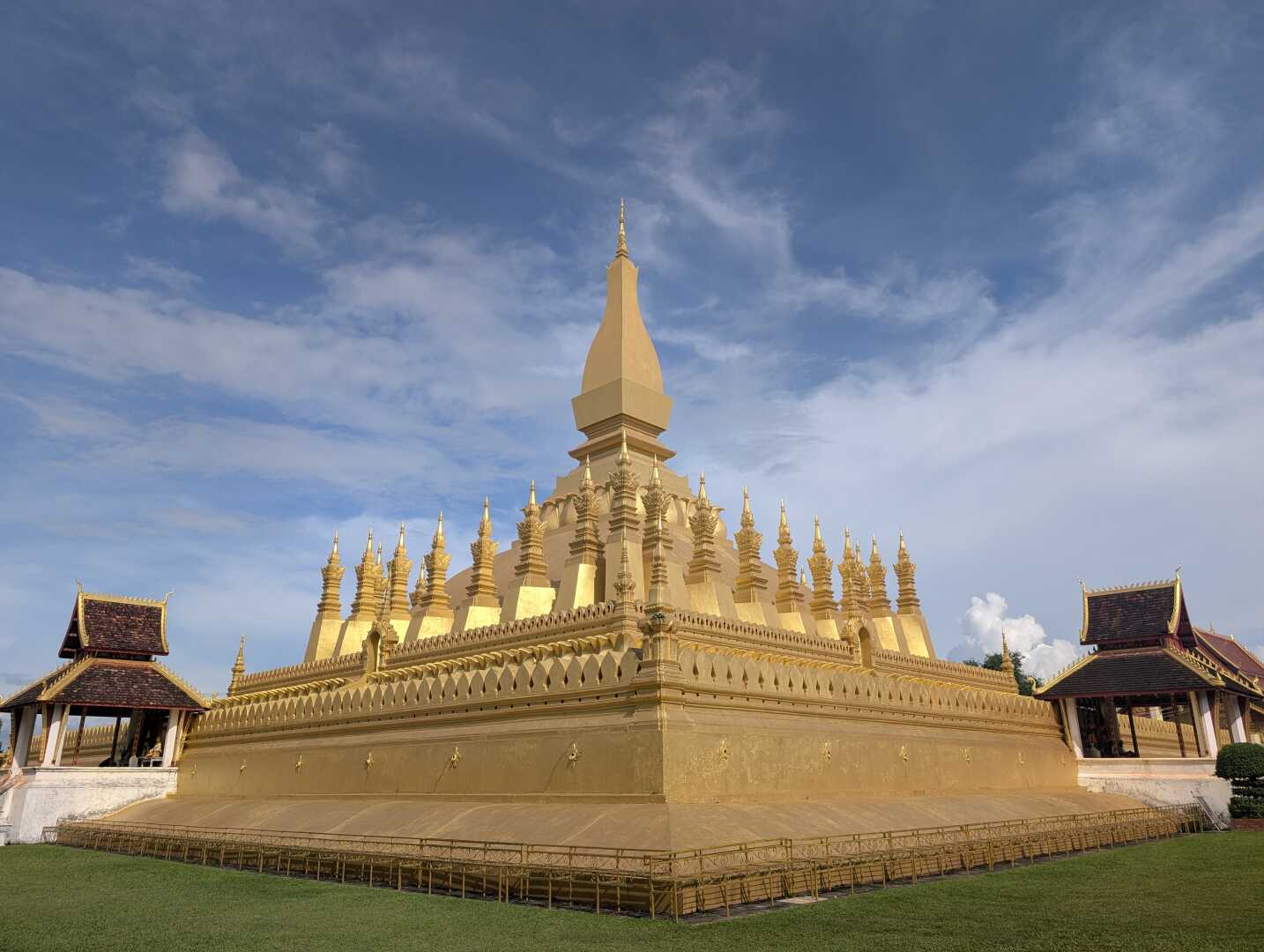 That Luang, the original stupa. The part reproduced in the museum's sculpture is the central spire, the one that represents Mount Meru.
In the late 1950s and early 1960s, in particular, the CIA launched the so-called “Pagoda Special Operation.” Within a few years it engineered an abrupt turnover of Vientiane's ecclesiastical leadership, which stood accused of siding with the Liberation Army of Laos (Ladwig, 2017). The Lao majority of the guerrilla movement had, in fact, been schooled in Theravada monasteries — often the only schools available in their home villages — and throughout the war the monasteries played a crucial role in circulating supplies and information between the towns and the guerrilla hideouts. The village monastery thus absorbed the anti-colonial class struggle: rather than sitting alongside the French educational institutions, it marked the fault line between external and internal powers, between the education of the people and that of the noble elite. Yet a dilemma of authenticity emerges clearly: during the war, who was entitled to transmit the teachings of the Buddha? The question did not concern doctrine, on which neither of the two sides dissented, but the title to transmission. This is exactly the type of conflict that the present text takes as its object: not a controversy over content, but over the signature.
Into the early 1970s, American bombs struck and razed several fifteenth-century monasteries on the Plain of Xiangkhouang, contemporaneous with, or only slightly later than, those of Luang Prabang. In the 1950s and 1960s the monasteries of Luang Prabang were instead completely restored and brought back to new life thanks to United States funds channelled first through USOM and then, from 1961, through USAID. A Buddhist population, the Phuan, was decimated and in very large part displaced. The royals of Luang Prabang, who consented to and requested the bombardments of their own territory, established themselves instead as the authentic descendants of the Bodhisattvas of the past. After the communist authorities seized power in 1975, a further purge began — this time to rid the monasteries of monks who had not embraced the revolutionary cause. But comparable processes, of course, swept across vast swathes of the state apparatus, from the police to the army, from the ministries to the schools. Two successive purges, conducted by opposed powers, on the same institution and with the same logic: to establish who is authorised to embody a continuity.
The period stretching from the declaration of independence to the second half of the 1980s remains poorly documented. Much of the available reconstruction consists of journalistic memoirs and chronicles assembled from a handful — in truth very few — of testimonies by people who lived through the era. The communist government sought total isolation, in part to work through, internally, the grief of the catastrophe that had unfolded. If they exist at all, the Party's archives are not yet open to consultation. Taking a wider view, what occurred in those years was a complex process of substitution: the old landed nobility — tied to, and enriched by, the French colony — was displaced by emerging powers from what had until then been the country's periphery. The new leadership, taken as a whole, was less educated and less cosmopolitan, and belonged largely to the country's peasant culture. The Cold War grafted itself onto these processes, breeding sharply dichotomous and irreconcilable readings of what followed. Even now, these divergent narratives generate a kind of background hum, as though the divisions that once drove the country to civil war were still latent and unresolved.
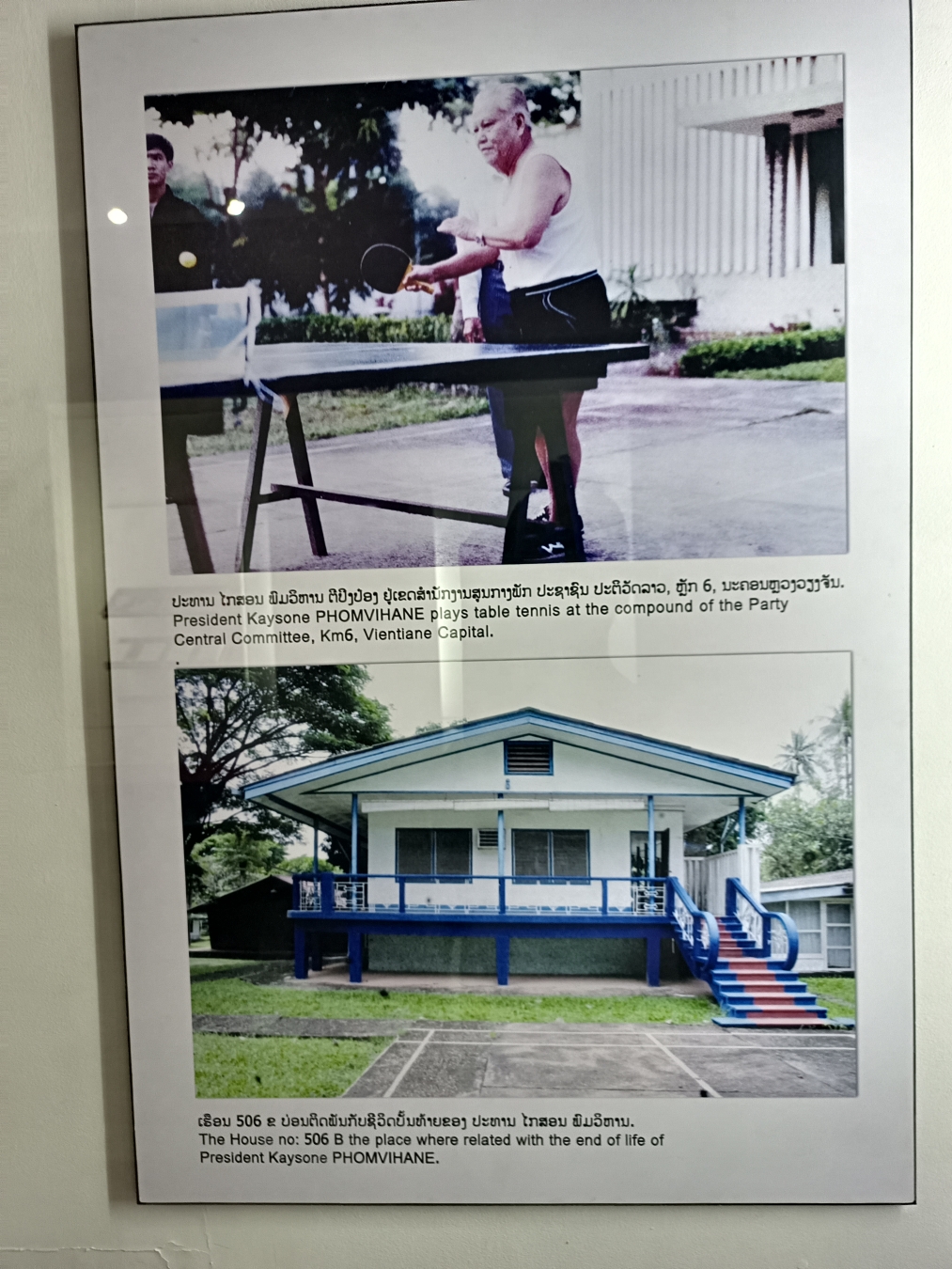 Kaysone playing ping-pong on the patio of the Party Secretariat's headquarters, and the house where he spent the last years of his life — both in Vientiane.
Immediately after the fighting ceased, the country endured one of the harshest famines in its history. As with Maoist China, the Western literature on the subject generally lays the blame on the land collectivisation carried out in those years. Yet there are no field studies capable of withstanding a rigorous historiographical scrutiny of the sources. There are, moreover, at least three further factors that are seldom acknowledged: the sudden contraction of arable land, the shortage of labour, and the absence of financing for any comprehensive plan of reconstruction. As to the first, valleys and rice paddies had to be cleared of mines before they could be farmed, but the fledgling government lacked the requisite technology — and its allies proved of little help. Furthermore, between 1973 and the early 1980s, for reasons as political as they were economic, at least 400,000 people emigrated to the USA, Canada, France and elsewhere. To these departures must be added the war dead and maimed — a figure never truly established, which could add as many as 200,000 to the toll. Given that the Lao population in the 1960s stood at around 2.5 million, one may safely infer that war and migration drastically thinned the ranks of men and women in the prime of their working lives. The new government of Laos thus faced the task of rebuilding nearly two-thirds of the country not only without funds or reconstruction plans, but having lost, too, much of the expertise it would have needed. It does not, therefore, seem excessive to argue that the reasons Laos is “the poorest country in Southeast Asia” cannot be reduced solely to the failures of the communist government. There are structural causes rooted in thirty years of war, together with the political and economic decisions taken in that “revolutionary” moment. Perhaps the most telling instance of this atmosphere — and of the enduring legacy of the Lao civil war in the country's internal and external relations — concerns Sisavang Vatthana.
It is useful to settle here a terminological question that the rest of the text will take for granted. Sisavang Vong, son of Oun Kham, ascended the throne of Luang Prabang in 1904 and was crowned according to traditional rites, but, as also explained in “Beyond the Nation”, his accession was immediately contested because of a procedural defect. Oun Kham’s successor should have come from the family of the Upparat (the vice-king), which at that historical moment was considered too close to the kingdom’s former Siamese protectors (Grant Evans 2002:77). Until 1930, the kingdom of Xiengkhuan did not recognise Sisavang Vong as “King of Laos” (Wolfson-Ford 2024). A similar argument can be made for some areas in the south of the country, where the new monarchy was never fully accepted (Baird 2024). When Sisavang Vong died in 1959, his son Sisavang Vatthana succeeded him and acted as sovereign throughout the Second Indochina War, but was never crowned. Officially, the coronation ceremony was postponed several times for budgetary and security reasons and never took place. In reality, many regarded Vatthana as an illegitimate king because the new system of dynastic transmission of power had favoured his family precisely by virtue of its unconditional acquiescence to French colonial power. In the chaotic phases that followed the Pathet Lao’s seizure of power, however, some local sources report that in 1977 he chose to face the consequences imposed by the new government, dying in a re-education camp, as happened to many other compatriots in the camps or amid the ruins of their homes.
During the Cold War, networks close to the exiled aristocracies reworked this episode around the new government's supposed intention to execute the king's son and extinguish his line. Christopher Kremmer's book Bamboo Palace (2003) renders this version tolerably well, emphasising above all the violation of the prisoners' human rights, the inhuman character of the re-education camps and the totalitarian drift of the Lao communist government. The title alludes to the bamboo hut where the king, Vatthana's consort Khamphoui and their eldest child ended their days, in Houaphan, at Vieng Xai itself. ne important detail is that bamboo was the most widely used construction material for elite houses in the precolonial period, and stood in stark contrast to the new royal palace given by the French to Sisavang Vong.
The affair has now been filed among the documents purporting to prove the human rights violations of the present Lao government, before courts in the United States and at the UN. It should be added that Kremmer's reconstruction rests on information gathered in the wake of denunciations lodged in the USA by members of a symbolic institutional body, the Lao government-in-exile — composed chiefly of former CIA collaborators and their descendants, and of the old Franco-Lao nobility, including Vatthana's nephew Soulivong Savang, who fled abroad and has today proclaimed himself King of Laos. This judicial entanglement is no minor matter: it furnishes a mandate that legitimises “searches for the truth” in a third country, conducted by unspecified orders, entities or individuals, at times by means hardly scientific — infiltration, profiling, covert intelligence-gathering.
In short, whatever one makes of the specific events, both Tibet and Laos share an abrupt rupture of a centuries-old political order — bound as much to myth as to tradition — in favour of an emerging leadership drawn from old centres of power seeking redress and from new productive and social forces, in a few cases formed abroad. In both countries, at the same time, there arises a mimetic and foreign alterity, the government-in-exile, whose primary function — beyond coordinating the diaspora — is to delegitimise the home government. Seen thus, the political trajectories of Laos and Tibet run in parallel. This owes partly to the common origin of the fractures that produced the two civil wars: both followed the upheavals that came with the end of the Second World War — the atomic bombing of Hiroshima and Nagasaki, the collapse of Japanese colonialism in Asia, the fresh invasions of South Vietnam and Korea, and the rise of new regional powers organised around communist doctrine.
Set against these regional processes, Tibet and Laos represent the most hidden and least known flanks of far larger wars of influence. Vatthana's story, however, stands opposed to that of the Dalai Lama on several analytical levels. In particular, several informed sources whom I interviewed on the subject support alternative interpretations of the events preceding his imprisonment, interpretations. In brief, Vatthana was informed of plans to imprison him and was offered the possibility of leaving the country. His refusal, however, was seen as an act of recognition of the new government and as an act of justice toward the Lao people. This is a historiographical possibility generally excluded from the dominant narrative but deserving of closer investigation. What would happen, then, if Vatthana’s fate, rather than being considered a state murder, were understood as a ritual sacrifice? I do not mean to suggest that his death was historically conceived or organised as such. I am interested in asking whether its narrative can be read through a political grammar of sacrifice and the substitution of sovereignty. If, instead of observing the event through the lens of human rights and therefore through the perspectives of family members or those close to him who experienced the “disappearance,” we inserted it into the socio-political structures of the precolonial kingdoms of the central Mekong, what might historiography tell us?
Two references help give shape to this question. The first is Kantorowicz: within the monarchical institution coexist a natural body, finite and perishable, and a political body referring to the eternity of the institution represented. The punishment inflicted on Vatthana consists precisely in separating the two — allowing the natural body to die of treatable illnesses in a bamboo hut, while the political body is transferred elsewhere. The second is Bloch, and in particular the theory of “rebounding violence” set out in Prey into Hunter (1992): ritual eliminates the transactional individual, with his negotiable biological vitality, in order to return that captured vitality to a transcendental entity, which emerges strengthened. What makes the Lao case remarkable is that the beneficiary transcendental entity is not the same one from which the victim came. The vitality of the chao sivit does not return to the monarchy: it passes to the people who survived in the caves and founded the Lao People’s Democratic Republic.
In other words, the confinement of Vatthana and his dynastic descendants might represent an exemplary but non-spectacular punishment that inhabited the symbolic order of the Luang Prabang monarchy itself. Without his people, emigrated and driven out of Laos, and without Franco-American military support, the king is alone and will die of hunger or treatable diseases, as often happened in the re-education camps. His death therefore does not take place in Luang Prabang, where his charismatic leadership remains present in the city’s architecture and in the memories of those who stayed, but in the places he failed to listen to while in power. He is therefore not a scapegoat. His sacrifice does not preserve the order unchanged: rather, it marks a new beginning.
The silent punishment inflicted on Vatthana — to die like any ordinary commoner — certainly concerns the belief that his reign was an imposture, that his power in life was illegitimate, achieved through colonial machinations and maintained through a horrific and foreign military force. Yet it also opens new fields of legitimacy. That same recognition of the communist government is today required of members of the diaspora who have decided in recent years to return to the country. In exchange, they receive part of the formerly confiscated property and the ability finally to live in peace in Laos as well. If, however, this version of events is followed to its logical conclusion, the Lao government in exile would appear as a legalistic contrivance more akin to a paramilitary group with coup-making aims than to a genuine political entity: a kind of Asian-flavoured Gladio, deployable at any moment for geopolitical purposes. In the 1960s something similar already existed and operated between Vientiane and Luang Prabang. It was called “Momentum,” and its description will be left to later texts.
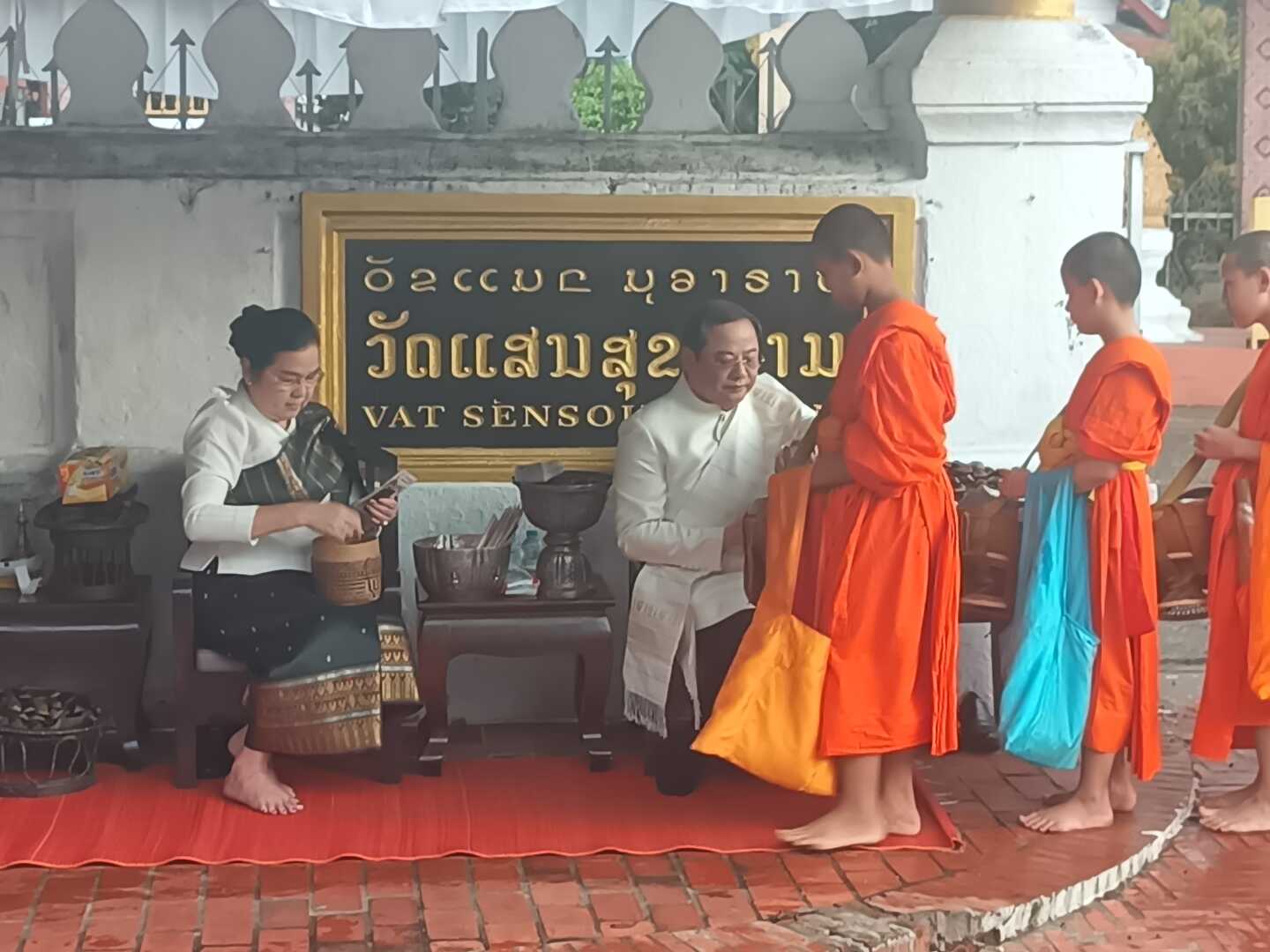 FIG.4 The Prime Minister of Laos, Sonexay Siphandone, and his wife Vandala during the morning Tak Bat, on the day of the boat race at the 2025 Festival in Luang Prabang, Laos.
Imagining Tibet
In Tibet, the government-in-exile — though backed by the same international actors — acts and legitimises itself through very different means and forms. The question is more many-sided here, for monasteries, reincarnation lineages, aristocratic families, trading networks and political authorities have long been interwoven. Nor has Tibetan Buddhism ever been a uniform reality: it embraces distinct traditions — Nyingma, Kagyu, Sakya, Gelug and many more — and developed across regions whose political relations were forever shifting: Ü-Tsang, K'am, Amdo, Mongolia, the Himalaya, Sichuan, Yunnan, Qinghai and Nepal. In this sense the territory we call Tibet, which covers roughly a third of China, never emerged in its long history as a unitary political entity. For centuries it was contested ground between Mongol and Chinese emperors, before becoming part of China under the Qing dynasty, enjoying a brief independence after that dynasty's fall, and finally being absorbed by Beijing with the rise of Maoism. Throughout its millennial history, local populations — often cut off for long stretches of the year — nonetheless retained broad forms of cultural autonomy. The Tibetan monastic institutions were places of worship, yes, but also schools, archives, economic centres and diplomatic hubs. Their autonomy rested on the capacity to train people, preserve texts, administer donations and maintain ties with communities scattered across vast territories.
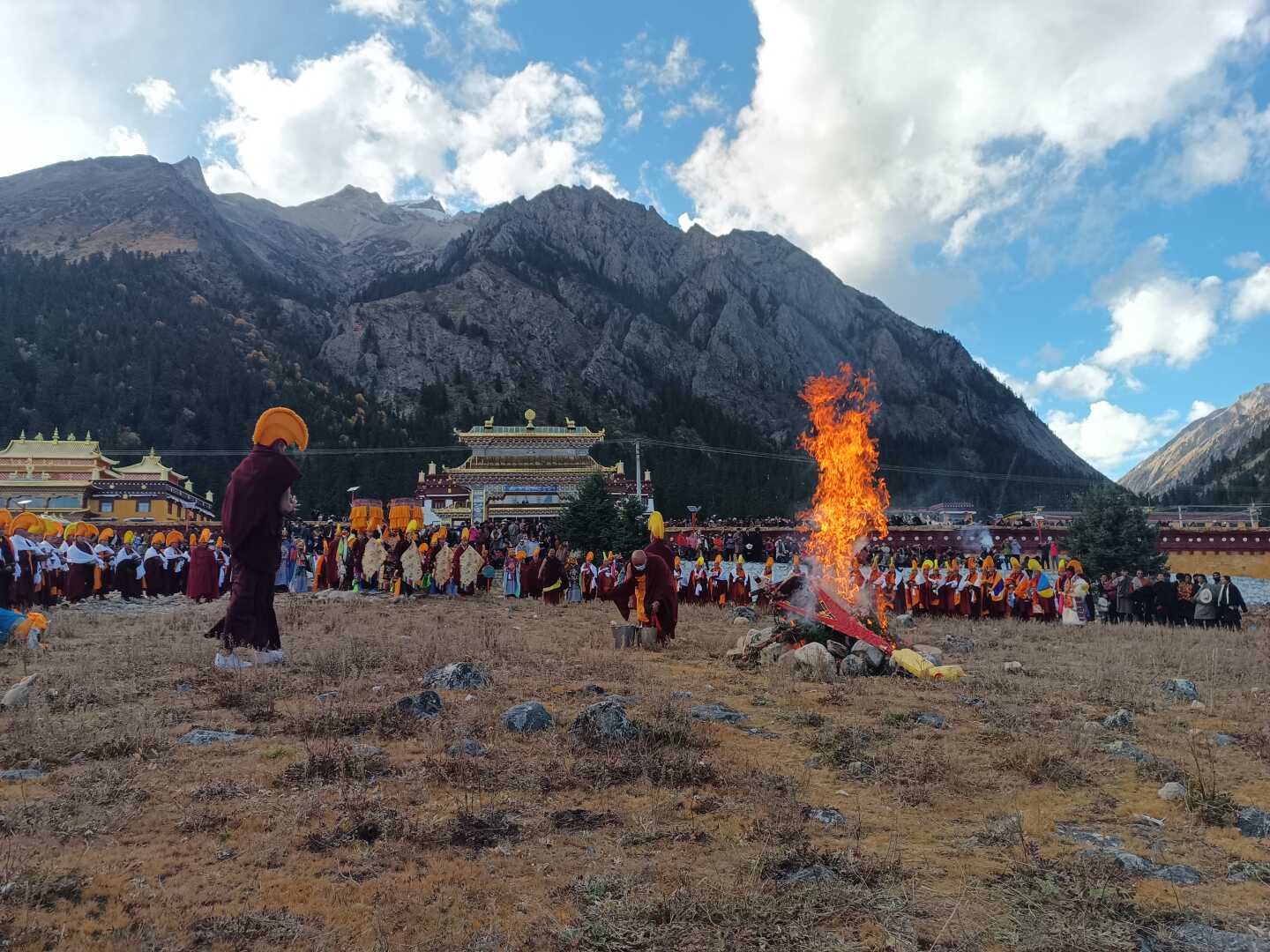 The New Monastery of Lenggu lies about three hours' walk down the valley from the old one. Nearly a hundred monks live there. In the photo, the final bonfire that allows the deities to return to the monastery.
The history of the Karmapas themselves belongs to one of the oldest schools of Tibetan Buddhism. Until the rise of the Dalai Lamas and the Gelug school in the seventeenth century, Dusum Khyenpa's Kagyu school was the most authoritative current within Tibetan Buddhism. It was recognised across much of Buddhist Asia, as far as southern India, above all for its deep grounding in yogic and meditative practice and in an intensely close master–disciple bond. It is precisely to the Karmapas that we owe the origin of the system of ecclesiastical succession by reincarnation — ever a source of fascination for Western observers of Tibet. The practice was devised to safeguard the monasteries' independence from outside influence, creating a succession of power managed entirely by ecclesiastical authorities. Even so, the children were often selected from the families of the wealthiest landowners and the Tibetan aristocracy, a fact that betrayed a constitutive tension within the monasteries themselves.
In the seventeenth century, for instance, the rise of the Fifth Dalai Lama and the Gelug school took shape amid military and political alliances. In 1642 the Mongol war leader Gushri Khan intervened on behalf of the Gelug coalition, defeating the rival powers of Tsang, which were close to the Karma Kagyu school. The Tenth Karmapa was forced to flee. This is no marginal episode — quite the reverse: as ever, struggles for dominion over the world of the imaginary and for theological supremacy demand political and military alliances. Yet the Gelug school also produced a sophisticated apparatus of government, composed of 175 monks and 175 laymen drawn from Tibet's principal aristocratic families. At its summit stood the Dalai Lamas — neither simply kings nor merely monks. Their authority rested on the belief that they were emanations of Avalokiteśvara, the Bodhisattva of compassion, but also on the administrative system over which they presided — grounded in rigorous curricula, philosophical debate and vinaya discipline — and on alliances with powerful families and relations with regional powers.
Until the close of the nineteenth century, the country's principal families numbered five; the families belonging to the lineage of the Dalai Lamas numbered six. To say that the abbots were often descendants of the region's leading families is therefore accurate. Some studies of Tibetan history go so far as to liken them to feudal lords — a label that would need refining case by case. In general, the tension between the “anti-nepotistic” function of the tulku and the risk of a symbolic sublimation of the dynasty lay at the very foundation of the institution of the Dalai Lamas. After all, the lama–patron relationship (Tibetan cho-yon) was a reciprocal symbolic bond between a Buddhist sovereign and a spiritual master: it was the most elementary form of the Tibetan orderings of power, a space of indeterminacy between the sacred and the political from which personal prestige and authority were drawn. Mythical descent certainly underwrote success, and hence the wealth and accumulative capacity of the noblest families. But it is equally true that these bonds were vital to the monasteries themselves, for they generated the flows of donation essential to sustaining and enlarging their buildings and their schools.
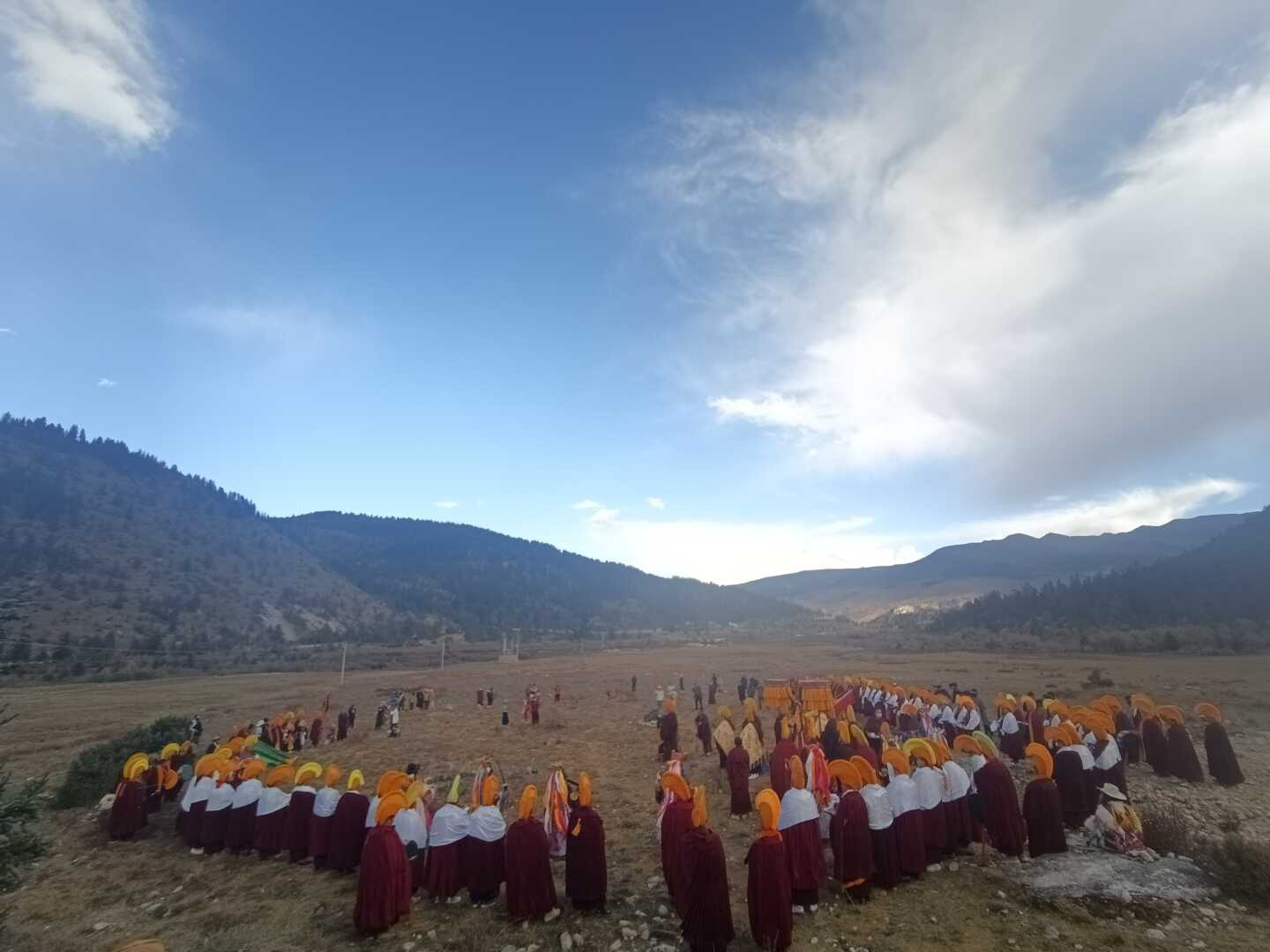 Monks in a circle who, with music and prayer, purify the monastery and make a new beginning possible.
It is precisely here that another distinctive feature of the region's monastery-centred forms of power resides: the school. The monastery was the apex of a rigid pedagogical system, in which children chosen at a tender age were trained in the spiritual practices that would lead them to enlightenment and to the fulfilment of their monastic — and, at times, royal — destiny. The Dalai Lamas were schooled in the art of governing through Buddhism, on a model that echoes the myths told in the courts and temples of many Southeast Asian monarchies, the kingdoms of the central Mekong among them.
As already noted with regard to the paintings of Wat Sisaket in Vientiane, the entire sim of the complex is frescoed with the tale of a kingdom crowned, at its summit, by a Bodhisattva. Among the principal courts of seventeenth-century Southeast Asia, the good Indianised king is almost invariably portrayed as a Bodhisattva, and as such his absolute power is bounded only by the Buddha's teachings — that is, by the Sangha (the monks). We are in a sacral dimension of royal charisma, produced by religious pedagogies, that turns on the sovereign's capacity to win the souls of his subjects — to make himself genuinely believed an ethical and divine leader. From this arise “relational” and “communicative” systems of government, founded first on the imaginary and then on the symbolic, that spread by influence outward from gravitational centres rather than solely through territorial control.
In Tibet, however, this mechanism performs a categorial leap: the Dalai Lama embodied the idea of the sovereign's absolute purity, not absolute power. We stand before what Tambiah (1976) has called a “galactic polity,” in which the centre does not directly govern a territory but radiates a moral power that fades with distance. On closer inspection, this form of power entailed a radical innovation: the dynasty was no longer biological descent but an incarnate spiritual community. Out of this overturning of dynastic rule there arose a kind of transgenerational property, embedded in the monasteries and legitimated by the religious practice of a chosen elite. The Potala of Lhasa — like the monastery of Songzanlin, the “little Potala” founded in 1679 under the patronage of the Fifth Dalai Lama near Shangri-La — housed a power at once otherworldly and administrative, a power descended neither from a divine mandate nor from popular choice: it was ancestrality that, reincarnating in the Dalai Lama, became government. It was, then, neither a Buddhist sharia nor the Chinese emperors' mandate of heaven, but rather — to my mind — the popular legitimation of a monastic pedagogical regime, at once open and elitist.
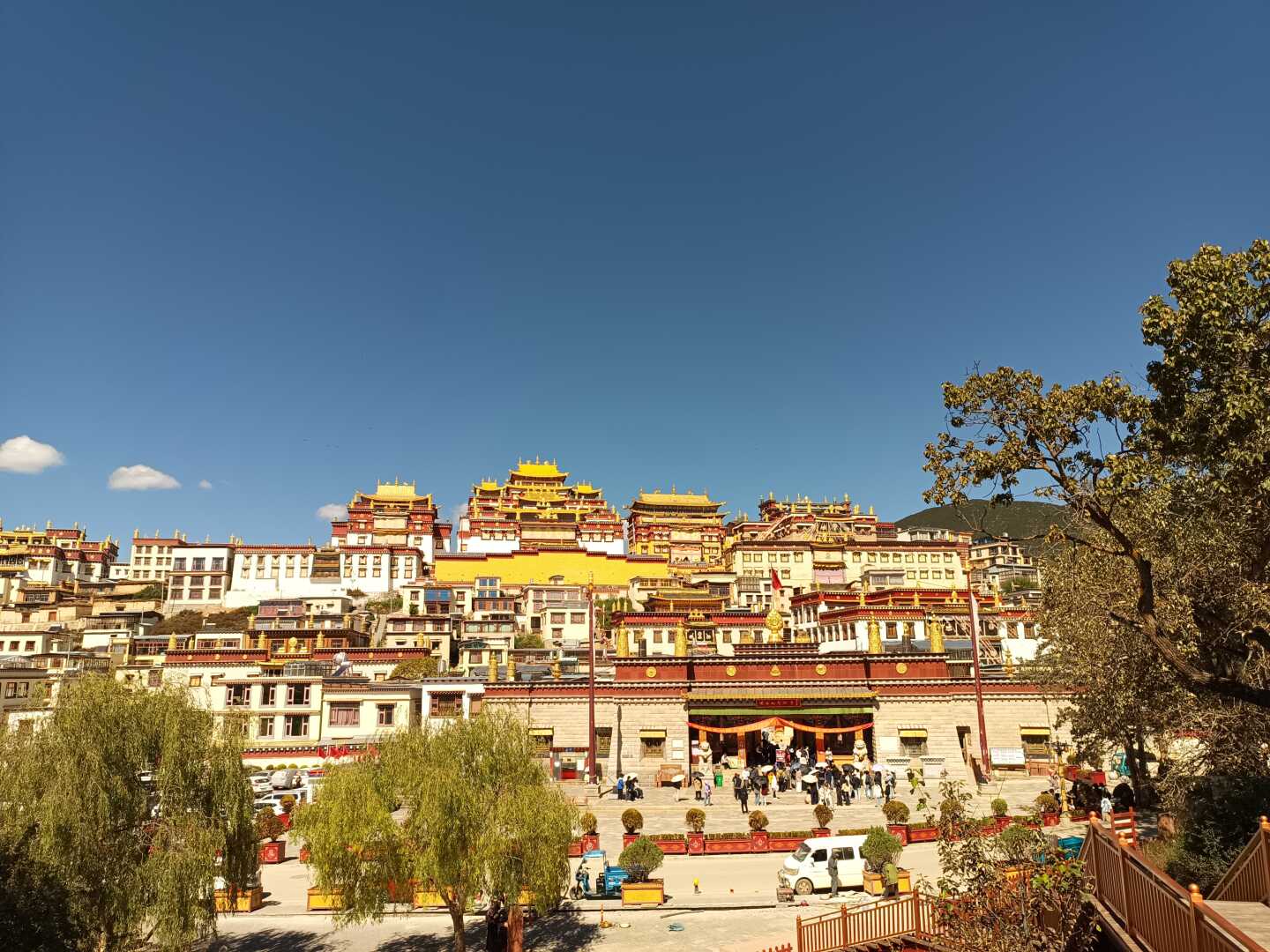 Songzanlin Monastery, the “little Potala,” Shangri-La, Yunnan.
Underpinning all of this is the classical Tibetan language, and its central function in the canon, the liturgy, monastic education and the transmission of religious memory. For this reason the monasteries will always remain incubators of a “Tibetanness” that outlasts any government's political will: their role springs not merely from the number of their monks or the grandeur of their buildings, but from their capacity to safeguard vocabularies, practices, genealogies and forms of authority that by their very nature exceed any imposed limit. If Chinese has for centuries been the lingua franca of commerce, classical Tibetan belongs to the vajrayana monks much as Pali belongs to the more scholarly theravada monks. The doctrinal difference over the “languages” of the Buddha is probably what most sharply divides the two vehicles. In vajrayana, however, the cult of the lamas remains an important part of monastic pedagogy across every school; hence classical Tibetan remains a load-bearing element of instruction. In many cases the monasteries become, over time, sanctuaries to the very abbots who once lived there: a telling example is the monastery of Dongzhulin, near Benzilan in Yunnan, founded to consecrate the passage from the Kagyu to the Gelug school even in the central areas of the region, whose ritual ascent leads to the tombs of the two lamas who founded it in 1667. It bears noting that sacralising practices are common to many religions: buddhahood, like sainthood, generates archetypes that the community systematises and transmits in varying forms. But whereas in the theravada monasteries the imaginary is dominated by the historical Buddha, his mudras and the tales of his former lives, the Tibetan monasteries are also a vast reliquary of monks, teachings, legends and texts produced within their walls — a cultural and philosophical heritage still largely awaiting exploration.
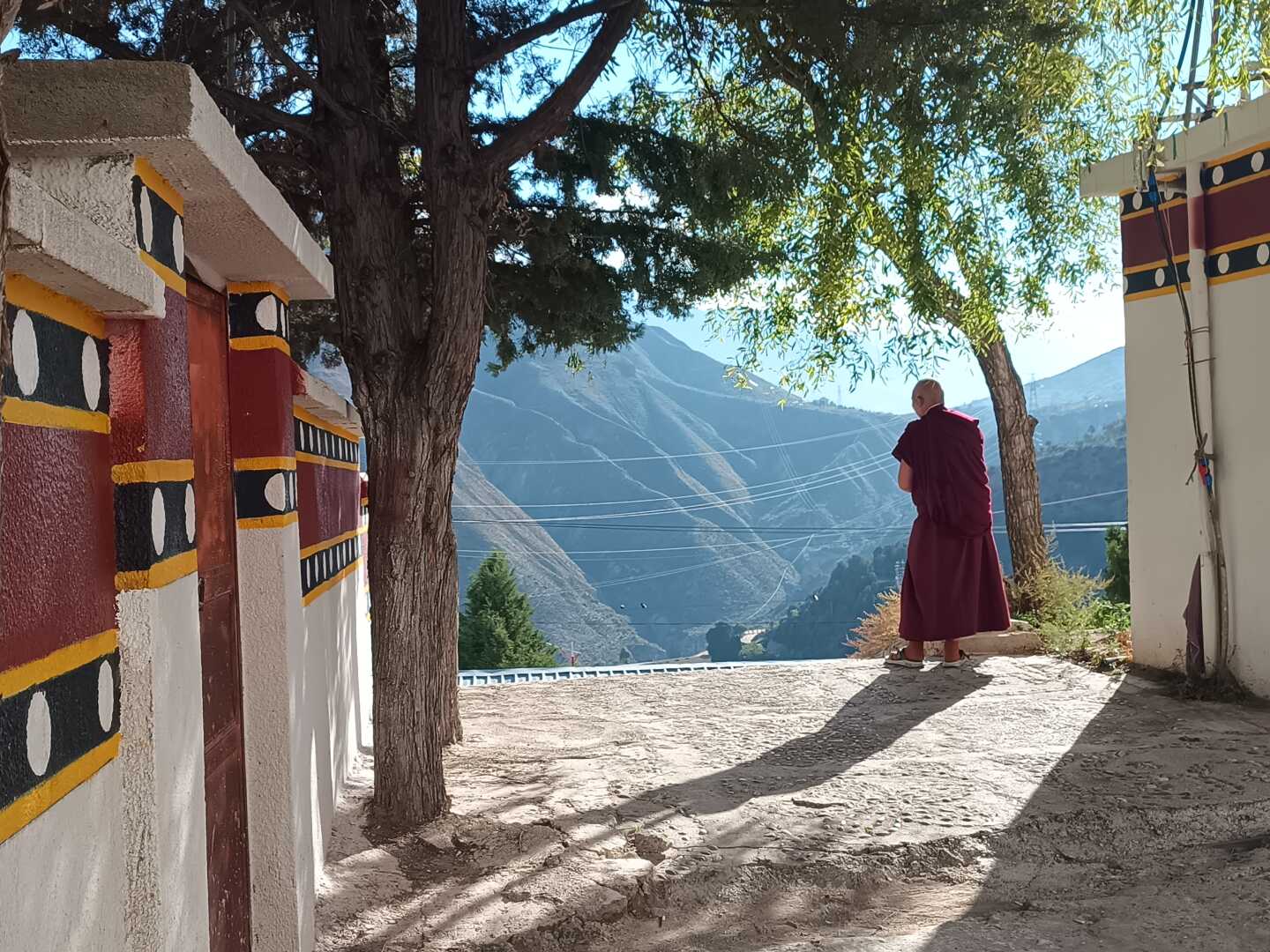 Dongzhulin Monastery, Benzilan, Yunnan.
What matters for the purposes of this essay is that the power radiated by the monasteries — articulated and diffused through alliances with political entities of every kind — possesses a formidable imaginative architecture. In the past the Dalai Lamas were received in Beijing like the true stars of their age: thousands thronged the city to glimpse the living Buddha and perhaps receive a blessing and a measure of good fortune. The emperors grasped at once the hidden power of these sacralised political figures: to have the Dalai Lama on one's side was a form of popular support from which any power could profit. The Dalai Lamas, in turn, were able to build a religious kingdom upon the charisma conferred by tradition — a case fairly unique in the region, which some scholars liken to Vatican City.
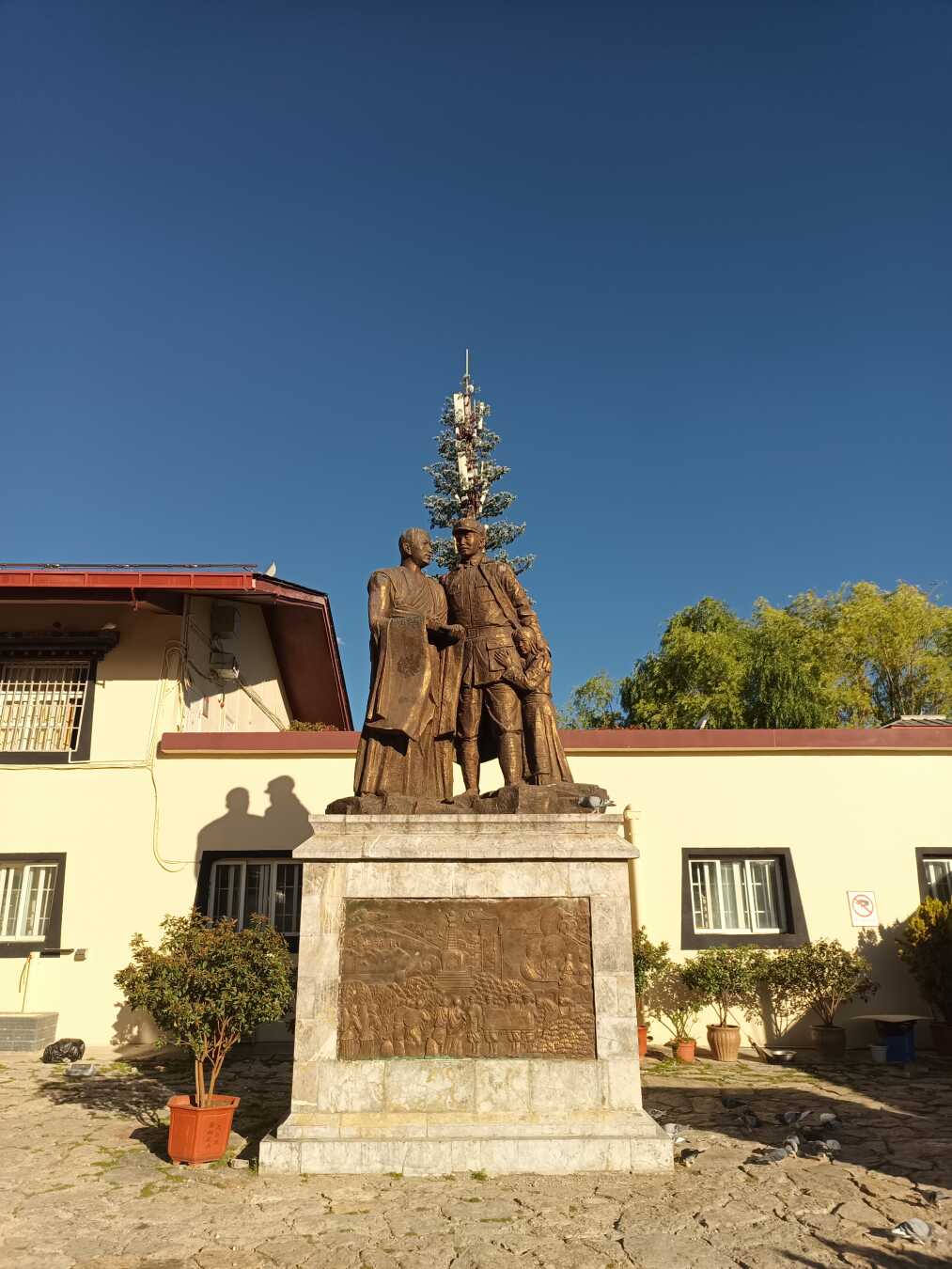 The reconciliation of the Liberation Army with the Tibetan monks: a statue on display in the courtyard of the Shangri-La town hall, Yunnan.
Granting that these general considerations hold — or are at least sufficiently intriguing — I should now like to turn to the essay's central theme: authenticity. That is, I want to compare the two cases presented here through certain essential aspects of the authenticity of power — what I believe will be one of the coming battlefields of the world.
Technologies of Authentication
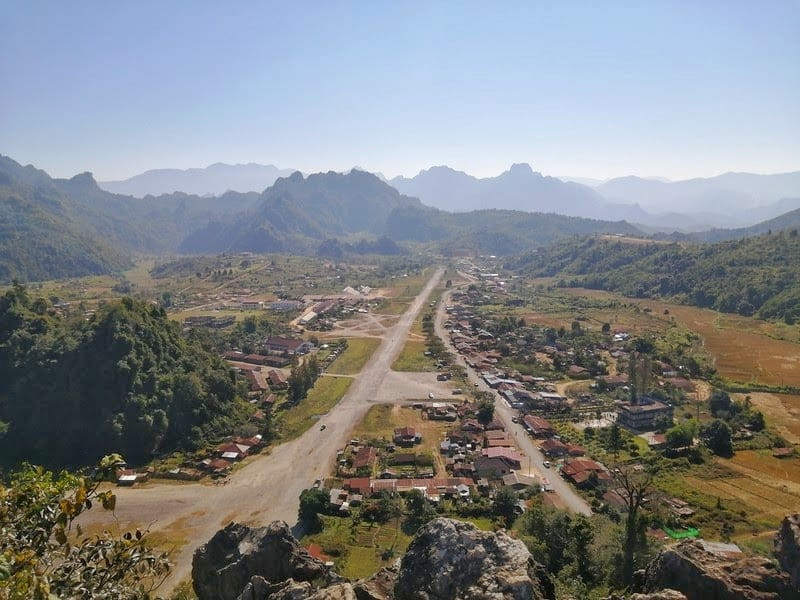 View of the CIA’s main paramilitary base during the Secret War (1961–1973). In the foreground are the remains of the airstrip, completed in 1964 and for several years among the busiest in the world. According to the thesis put forward by Alfred McCoy in 1972, most of the opium produced in the northern regions of the country passed through here. Since then this claim has been contested, qualified and reasserted depending on who tells the story. Long Tieng, Xaisomboun Province, Laos.
The question of true and false always comes after someone has established a procedure of verification. The authentic is therefore not something outside power, but its retroactive signature: it presents itself as already given, prior to the operation that produced it. In Deleuze and Guattari’s formulation (A Thousand Plateaus, 1980, plateau 13), the apparatus of capture contributes to constituting what it captures. To ask “is it authentic?” therefore means that one has already situated oneself within an apparatus that possesses the right to answer.
Authenticity, in this sense, is not a property of power but an effect of procedure. When it takes the form of a certificate, a label or a blue check — when, that is, it materialises — it becomes analysable as a dispositif. Appellations of origin, heritage brands, verification badges and even the “be yourself” imperative of the wellness industry belong to very different worlds, yet share one operation: they establish procedures, discourses and forms of recognition through which a claim to origin, identity or continuity is validated. I will call these apparatuses technologies of authentication. The expression authenticity of power therefore does not designate an authenticity possessed by power, but the power exercised by every procedure that establishes who or what may be recognised as authentic.
There is a tension in power toward the authentic that Chinese historians and philosophers debated for centuries. 正統 zhèngtǒng is the authenticity of power understood as its transmission. It refers to systems of dynastic succession, dividing them between dynasties produced by orthodox transmissions and dynasties classified as 閏, “intercalary” or transitional, or 僭, usurping. In the imperial order founded on the Mandate of Heaven, authority is transcendental in origin, but the title is never granted once and for all: it can be revoked, and its revocation is established retroactively by the fall of the previous house. Victory makes legible the mandate that would have made it possible. Respect for protocol and purity of dynastic transmission thus operate as seals of imperial authenticity. Yet authentication also passed through another decisive operation: the official history of each dynasty was compiled by the dynasty that succeeded it. The victor, in other words, also writes the register against which its own succession can later be verified. This circularity is not simply a flaw in the system: it is one of its mechanisms.
What takes the form of a state protocol in the Chinese empire may elsewhere be incorporated into everyday practices that have no specific name. To hold these different scales together, I draw on Maurice Bloch’s distinction (2008) between the transactional social and the transcendental social. The former is the dimension of interaction among present subjectivities: negotiation, exchange, alliance, conflict. It is unstable and continually renegotiated. The transcendental social, by contrast, consists of roles, groups and essentialised entities — the chief, the wife, the elder, the clan, the nation, the ancestors — that exceed the individuals who temporarily embody them and can continue to exist even in their absence. Bloch shows how kingdoms and states may appropriate these essentialised representations in order to present themselves as totalities capable of giving completeness to an otherwise fragmented and incomplete social world. In systems where the political is inscribed within a wider sacred order, this operation necessarily entails transformations, concentrations and reorganisations of existing symbolic systems. The problem that interests us here is the following: if the transcendental social exceeds contingent interactions, through what operations does it return to manifest itself in the transactional world? How does it become recognisable? Who possesses the authority to validate it, by what procedures and before what public?
I therefore call technologies of authentication the ensemble of social, ritual and administrative operations through which the transcendental is periodically re-anchored to the transactional. My hypothesis is that these technologies help make it credible, durable and, in some cases, even consultable. From this perspective authenticity is not simply preserved: it is produced through identifiable apparatuses. A first distinction will be useful. Some regimes of authentication operate by threshold: they establish whether a subject belongs or does not belong to a category, whether it is true or false, legitimate or illegitimate. Others operate by gradient: what matters is greater or lesser proximity to a centre, the different intensity with which one participates in its authority or power. In the first case discontinuity dominates; in the second, distance. We must therefore enter into the different forms of the transcendental social and the historical formations that organise its validation.
In Chinese dynastic kingdoms, subjects did not figure as recognised validators: no procedure assigned them a signature. They were not, however, irrelevant. Doctrine could read rebellion as a sign that the Mandate of Heaven had been revoked. But to be the index of a validation is not the same as participating in the procedure that establishes it. In Tibet, succession by reincarnation presents the problem differently. Reincarnate transmission replaced purely hereditary transmission and provided monasteries with an embodied, replicable transgenerational continuity. The validator was a college of ecclesiastics that recognised the child through signs, tests with objects and oracular responses. In 1793 the Qianlong Emperor superimposed upon these practices the Golden Urn, presented as a remedy to corruption and to the suspicious recurrence of reincarnations within already influential families. Signs, objects and oracles continued to operate, but they produced a shortlist of candidates upon which a new procedure intervened. What matters is not that decision disappeared, but that its authorship was redistributed. The result could appear as the product of karma, oracle, chance or protocol rather than of the will of a single actor. Whoever establishes the procedure does not necessarily determine each of its outcomes, but establishes the conditions under which an outcome can be recognised as valid. Even the imperial dispensations that allowed the drawing to be suspended do not necessarily constitute exceptions to the dispositif: rather, they show that the power to suspend a procedure forms part of the authority that established it.
The colonial encounter at the end of the nineteenth century and the subsequent formation of nation-states in Southeast Asia produced a decisive variation. In Deleuze and Guattari’s terms, the colonial machine of the Despot institutes the categories within which bodies will subsequently be distributed. The new subjects are counted, mapped, ethnically classified and inscribed within historical narratives. As Benedict Anderson (1991) observed, census, map and museum participate in constructing modern populations as quantifiable and administrable entities. The process can be divided into two moments. First a descriptive grid is produced; then individuals, territories and objects are verified against that grid. Classification, register and verification thus form a single sequence of authentication. One element must be added that Anderson leaves implicit and that is decisive here: the grid is produced from above and cannot be challenged from below, because those inscribed within it do not possess its access codes. One can be counted, but cannot contest the count. Anderson, however, does not describe these operations as simple falsifications of the world. Communities are not distinguished as true or false, but by the manner in which they are imagined, and “imagined” does not mean imaginary. The same caution applies here: to define authentication as a dispositif does not mean claiming that what it authenticates is false. It means shifting the question from the object to the procedure, and from the procedure to the authority that institutes it.
The Lao case is particularly instructive. Before the arrival of the French, Laos was not absent from political history: the kingdom of Lan Xang, founded in 1353, had fragmented at the beginning of the eighteenth century into the kingdoms of Luang Prabang, Vientiane and Champasak. Sovereignty, however, did not necessarily assume the form of a territory bounded by linear frontiers. In the mandala model described by Tambiah, centres radiate authority with decreasing intensity, and peripheral areas may simultaneously recognise more than one centre. This system does not eliminate authentication: it arranges it according to another geometry. Belonging does not operate as a threshold — inside or outside, true or false — but is distributed along a gradient of proximity to the centre. What must be recognised is not an exclusive identity but a position within shifting networks of dependence, protection and power.
In this context too, validation could take the form of a public act performed by subjects recognised as capable of carrying it out: chiefs, ritual specialists, religious authorities. Its effectiveness did not necessarily depend on the existence of a separate archive, but on the possibility that recognition would periodically be made visible before a community competent to interpret it. Celebration can therefore be understood as a particular technology of authentication. What elsewhere is preserved in a document can be preserved through repetition. Ritual does not allow the past to be consulted like a library; it makes it present again. Repetition thus produces a form of performative consultability.
In Luang Prabang, the tak bat, the monks’ morning alms round, can also be observed from this perspective. An urban legend claims that the practice has continued daily for more than six hundred years. It is therefore significant that it is imagined and narrated in this form: daily repetition connects the present city to a duration that exceeds the lifespan of its inhabitants. The tak bat also structures urban space and time, organises relationships among monasteries, families and visitors, and is today one of the city’s most visible public events. Touristification has produced a new economic and ritual circuit around the alms round without erasing its capacity to stage a recognisable continuity: it is here that the religious and memory capitalism evoked at the beginning can be observed every morning. In this sense, as Bloch had already observed, ritual functions as a living archive in which the transcendental is not merely enunciated but performed, and thereby authenticated on a daily basis. It does not simply assert that Luang Prabang is a Buddhist city; it makes continuity visible through bodies, routes, gestures and repetitions. From the point of view of technologies of authenticity, it is therefore a procedural rather than propositional register.
With colonial administration, the problem again changes scale. A series of administrative, educational, religious and heritage practices contributed to making what would be recognised as Laos more coherent and legible as a territorial unit. The restoration of monasteries, the reorganisation of institutions, the circulation of officials and the production of a teachable history of the territory were not merely administrative interventions: they participated in constructing the registers through which a new political totality could be recognised (Ivarsson, 2008). The reorganisation of religious education can also be read within this framework. The creation of a Pali school intended to reduce monks’ dependence on neighbouring Siam did more than increase the institutional autonomy of the local clergy. It also localised the training of religious specialists and therefore the reproduction of those who would be authorised to interpret, transmit and validate a particular Buddhist continuity. These operations served different purposes and cannot necessarily be reduced to a single coherent project. Taken together, however, they contributed to producing Laos as a political entity distinct from Siam and recognisable as one unit among others, even within French colonial rule. As Thongchai Winichakul observed in Siam Mapped, the “geo-body” of Siam produced the Lao margin as the residue of someone else’s cartographic operation. The state that gradually emerges from these operations therefore does not simply inherit an identity already available: it helps construct the procedures through which that same identity can, retroactively, appear as its own.
This is the paradox Prasenjit Duara (2003) isolated in his study of Manchukuo, a state created in 1932 in Manchuria, northeastern China, after the occupation of the region by the Japanese Kwantung Army. It existed until 1945 and formally possessed almost everything a state should possess, including a head of state — the last Qing emperor, deposed by the revolution of 1911–12. The effective centre of power, however, was the Japanese military and political apparatus. In his text Duara does not deny that Manchukuo was a puppet state: he denies that this observation is interesting. The point is that the Japanese found themselves facing an impossible and revealing task — producing an independent country that was profoundly dependent, manufacturing authenticity through inauthentic means — and that to accomplish it they had to capture pre-existing and transnational civilisational resources. Manchukuo thus appears not as the pathological exception to modern sovereignty but as its laboratory case, where the staging is too recent to have sedimented and therefore remains visible. In colonial Laos the same thing occurs, with only a slightly greater delay of sedimentation: the unity of the kingdom is authenticated through instruments supplied by the very power upon which that kingdom depends.
Reweaving the Threads
To conclude this long excursus, it is now worth returning to the distinction left suspended between thresholds and gradients and rereading the material gathered on this new basis. As we have seen, the precolonial political systems of the central Mekong and the Tibetan plateau function predominantly by gradient. Tambiah’s mandala and the galactic polity do not ask anyone to be inside or outside: they ask how close one is, with what intensity one participates, how often tribute is rendered. A frontier village could recognize two centers without contradiction, because all thresholds were managed locally, usually through rites of passage. The cho-yon itself is a graded relationship, not a belonging. And the tak bat is the everyday form of this regime: no one is admitted or excluded at dawn; everyone is more or less participant, more or less present.
The colonial apparatus, by contrast, strengthens threshold machines. The census assigns one ethnicity and not two; the frontier separates an inside from an outside; the museum distinguishes heritage from everything else. The specific violence of these technologies lies not in what they assert but in the conversion they impose: they force a world of gradients to declare itself in binary terms. Whoever lived on a shared margin must now appear on one side alone. The tulku occupies an instructive position because it is a threshold located within a system of gradients. Recognition of the child is a binary act — this one and no other — introduced into an order that otherwise measured only proximity and intensity. The Golden Urn merely proceduralises that threshold, removing it from the local college and transferring it into an imperial protocol. And this is why the conflict over reincarnations remains the harshest today: thresholds admit no compromise, while gradients do.
The dispute over Kaysone’s Laoness, from which this text began, is the same conflict transferred onto the person. Patrilineal descent is a threshold and admits no degrees: in the Lao nationalist thinking, if the father is Vietnamese, the son is Vietnamese, and no amount of monastery life or guerrilla struggle can alter the verdict. Maternal transmission, education in the vat, and the years spent in the caves are instead magnitudes that accumulate by intensity. Those who accuse Kaysone of impurity do not bring different evidence: they bring a different register. And it is significant that the threshold register is precisely the one the French had helped fix by rewriting the rules of succession in Luang Prabang from 1904 onward.
The same logic governs the pair that runs through both cases. Government at home and government in exile constitute a perfect threshold, with no intermediate degrees: either one or the other, either authentic or puppet, with the accusation circulating symmetrically in both directions. The return of the Lao diaspora is precisely the recrossing of that threshold — the government is recognised, and in exchange one recovers a position on a gradient: part of one’s property, the possibility of living in peace, a proximity once again open to negotiation. Vatthana’s death, read through Bloch and Kantorowicz, performs the same operation at the level of the sovereign: it eliminates the natural body in order to release the political body and allow it to pass elsewhere.
And it is here that the Museum of Resistance can be read for what it is. Kaysone, the sahai, is neither the chao sivit nor the chao fa of the tradition that the museum nevertheless stages. The revolution did not replace one cosmology with another: it shifted the validator. It left standing the stupa, Meru, the dhamma and asceticism, and positioned itself at the point where it is decided who may legitimately embody them. This, I believe, is the true object of technologies of authentication — not the fabrication of the sacred, which none of these powers ever attempted, but the conquest of the signature that certifies it. And if I am right to think that this will be one of the battlefields of the coming decades, then the question to carry elsewhere is not which sovereignty is authentic, but who possesses the power to declare the sovereignty of others inauthentic.