Installing SYE and CV Driveshaft on a Jeep Cherokee XJ
One of the most frustrating experiences for any lifted XJ owner is the dreaded driveline vibration. You install a beautiful 3-inch or 4.5-inch lift, bolt on aggressive tires, and suddenly your Cherokee hums and shudders every time you accelerate. The culprit is almost always the factory slip yoke setup. When you lift an XJ, the angle of the rear driveshaft steepens dramatically. The stock slip yoke—which slides directly into the transfer case—has limited travel and cannot handle these extreme angles, resulting in binding, vibration, and premature wear. The solution is a Slip Yoke Eliminator (SYE) paired with a CV (Constant Velocity) driveshaft. This combination is widely considered the gold standard for lifted XJs, and for good reason.
Why an SYE is Essential
The factory transfer case output uses a slip yoke that moves in and out of the tail housing as the suspension cycles. On a lifted Jeep, the driveshaft becomes shorter and operates at a steeper angle, causing the slip yoke to barely engage with the internal splines. This leads to vibrations that many owners try to mask with transfer case drops, but that's only a band-aid. An SYE kit replaces the stock slip yoke with a fixed output flange, effectively shortening the transfer case and allowing the use of a much longer CV driveshaft. The longer shaft operates at shallower angles, eliminating vibrations. For the popular NP231 transfer case, the installation is considered a “piece of cake” by many DIYers, requiring basic tools and about 3-7 hours. Even the NP242 benefits from heavy-duty SYE kits that increase output splines from 27 to 32 for added strength.
Choosing a CV Driveshaft
Once the SYE is installed, you need a matching CV driveshaft. Unlike the stock shaft, a CV (or double cardan) driveshaft has two u-joints working together at the transfer case end, allowing for much higher operating angles without binding. Brands like Adams Driveshaft and Ten Factory offer heavy-duty 1310 series CV shafts specifically for lifted XJs. Adams uses DOM tubing and either greaseable or solid non-greaseable Spicer u-joints, with extreme-duty versions rated for up to 38-inch tires. Ten Factory shafts are compatible with lifts up to 4 inches and come with a complete hardware set. Crucially, do not order a custom CV shaft until the SYE is physically installed on your vehicle—you will need to measure the exact running length between the transfer case yoke and the rear axle pinion to get the correct fit.
Proper Pinion Angle Setup
Installing the hardware is only half the battle. With an SYE and CV shaft, your rear axle pinion angle must be set differently than stock. For a CV driveshaft, the pinion should point directly at the transfer case output. In practice, you want the pinion yoke to be parallel to the driveshaft angle, with a slight 1-2 degree downward tilt to account for axle wrap when accelerating. If you have leaf spring perches that are not yet welded, wait until the full weight of the Jeep is on the suspension, install the new CV shaft, then rotate the pinion with a jack until it aligns perfectly with the driveshaft before welding. If your perches are already fixed, you will need angled shims (typically 4 to 6 degrees) to correct the geometry.
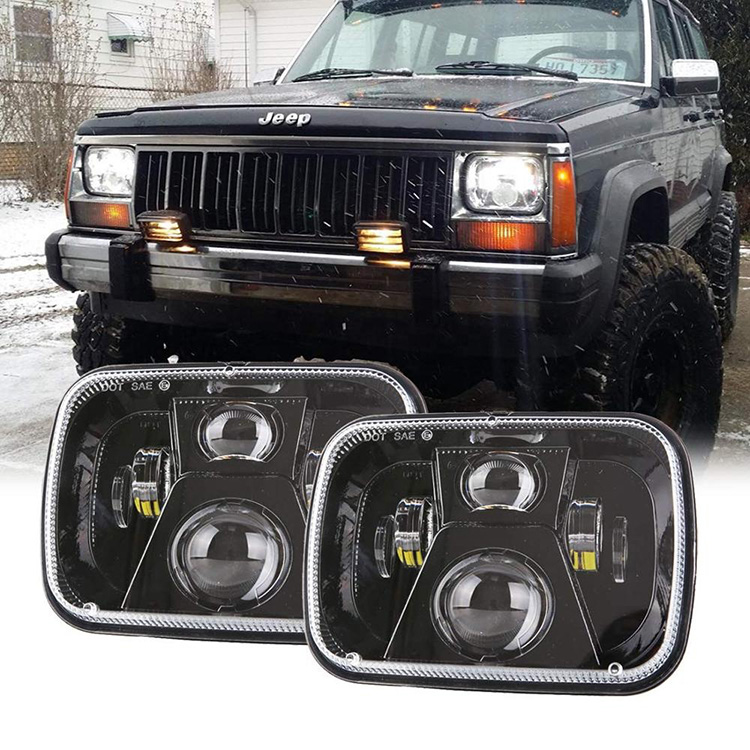
One of the most overlooked connections in this entire process is between your newly smooth driveline and your Jeep Cherokee XJ headlights. It seems unrelated, but hear this: a lifted XJ that sits higher in the rear than the front—common after an SYE conversion if you don't correct the stance—throws your headlight beam angle into the trees or directly at oncoming windshields. More importantly, forum veterans have long warned that upgrading the electrical system is essential when modifying an XJ. The factory headlight wiring lacks relays, and if you install higher-powered bulbs without a relay harness, you risk burning out the expensive and hard-to-replace headlight switch. An aftermarket wiring loom with relays draws power directly from the battery, reducing the load on your switch and delivering full voltage to the bulbs. This makes your headlights dramatically brighter—an absolute necessity when you are testing out your new vibration-free driveshaft on dark, remote trails at night. Additionally, every time you modify the suspension (including an SYE install), you must re-aim your headlights. The change in ride height and stance alters the beam projection, and failing to adjust the housings creates a safety hazard for you and everyone else on the road.
The Bottom Line
Driving a lifted XJ without an SYE and CV shaft is a compromise at best. You are relying on a transfer case drop to reduce angles, which sacrifices ground clearance, or you are simply living with the vibration, which destroys u-joints and transfer case bearings over time. By installing an SYE and a custom CV driveshaft, you restore smooth operation, regain lost clearance, and build a driveline that will handle years of off-road abuse. Take your time with the installation, get those pinion angles perfect, and while you are under the hood, do your XJ a favor and upgrade the headlight wiring. You will finally be able to drive at highway speeds without the annoying hum, and you will actually see where you are going when the sun goes down.