numero #1
Um projecto libertário, sereno e racional
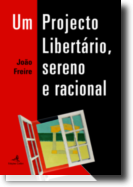
The book “A Libertarian, serene and rational project” published by Edições Colibrì, Lisbon (2018), is a career-ending work by Portuguese sociologist and activist João Freire, Professor Emeritus of the University Institute of Lisbon (ISCTE).
Quoting the author, “this book proposes a renewal of anarchist ideology for the twenty-first century.” Freire begins the book by giving a brief preface on modern and contemporary anarchism. As early as the 1960s and 1980s, the author reports, efforts were made to formulate a modern anarchism, with a historical memory, but seeking responses to the demands of modern times. These included, a booming economy, advanced technologies, urbanism, globalization, increasing complexity of social life and the ever-present risk of catastrophe. However, these efforts foundered. They did not contribute to the reform of the political practices of militants, nor did they improve the reputation of this political philosophy, leaving the usual prejudices behind.
Freire with this book wants to leave to the future generations a balanço de uma geração (i.e., a balance sheet of a generation), written by those who will soon be leaving the scene. This political testament is divided into two main chapters. The first, aimed at reassessing the role of the power state, proposing strategies for political intervention within the democratic system. The second, addresses the issues of the market economy, calling for its proper regulation in order to achieve a more dignified alternative to the current level of globalization.
In the first chapter, Freire begins to deal with the difference between power and the state, and to emphasize the centrality in the modern state, of one in the other. Power can never be abolished, except by the disintegration of society, returning to a primitive state, which no one nowadays seems to really desire – says Freire. However, power can be more concentrated, or conversely more socialized, as suggested by Spaniard Tomás Ibáñez in “Por um poder político libertário” (in Actualidad del anarquismo, 2007). Freire then gives a brief historical survey of the societies, concise but rich in names, dates and references, leaving various insights for the reader: the monarchies reigning “in the name of God,” the different forms of republics, the Western values of the last two centuries, the independence uprisings of various regions, the national and supranational state, the Russian revolution and the Cronstadt sailors’ revolt (1921)-fighting for a workers’ democracy and not for the dictatorship of the proletariat, the Ukrainian Makhno , the Italian Risorgimento and Errico Malatesta, post-Napoleon III France, Stirner‘s individualist anarchism, the Fédération Anarchiste, the International Workers’ Association (AIT), the first and second postwar, Colin Ward, various American thinkers (Henry David Thoureau, Emma Goldman, Murray Bookchin, Noam Chomsky,..), opium war and Mao Tsé Tung, Spanish and Latin American, African and Portuguese movements.
Freire points out, “the classical anarchists almost all dreamed of a revolutionary transformation of aristocratic-bourgeois society.” However, the German Landauer (1907) lucidly discussed the conditions and effects of both revolution and evolution (i.e. with reforms), suggesting as “preferable the most peaceful and gradual paths.” The author then begins to argue for the idea of a libertarian anarchist party, bringing as examples Italian (by Malatesta and Merlino, 1891), French (Fontenis, 1953), and Spanish (Olivier and Prieto) experiences. He also points out some libertarian elements, among modern and contemporary political parties.
For Freire, institutions of intermediation with the citizen -such as parties should be- are necessary in complex societies. In addition, ideologies such as libertarian municipalism (e.g., Emídio Santana, M. Bookchin), could foster the widening of the people’s spaces of direct democracy in the management of their local interests. Freire warns about the risk of sectarianism in so-called anarchist militancy, which has always coolly welcomed such initiatives. “It is a fact that it is since the 1930s that anarchism has ceased to count for contemporary societies, after the end of anarchist syndicalism and with the continued opposition to any electoral project.”
Freire then begins to envision the detailed characteristics of the libertarian party, writing a full-fledged manifesto. At the heart of such a party would be the creation of community interest groups, a forum for citizens, and a gradual move away from power. There is no shortage of examples adopted by contemporary states for real solutions to possible risks and consequences. Freire also reflects on the control of violence (war, police, prisons) inherent in every state, as well as propaganda and manipulation of information.
The second chapter includes reflections on economic development after the American and French revolutions (socialism vs. power bloc, east vs. west, decolonization, capitalism). An interesting passage is the anachronistic recognition of the concept of “social class,” which, according to some contemporary sociologists, should be transformed into “social network” on the basis of ideology, profession, or affinity. The ideas and experiences of various thinkers regarding a non-competitive economy are then presented, such as Pierre-Joseph Proudhon, Josiah Warren, William Greene, Lysander Spooner, Benjamin Tucker, Pyotr Kropotkin, E. Maletesta. Freire, also analyzes some socio-economic features of past revolutions (in Mexico, Ukraine, post-Tzarist Russia, the Spanish Civil War) and communist and socialist societies. The last section is devoted to observations on competitive and global capitalism.
Version in Italian printed on Ruas MI #1.
Links: Edições Colibrì https://www.edi-colibri.pt/Detalhes.aspx?ItemID=2229 Tomás Ibáñez https://es.wikipedia.org/wiki/Tom%C3%A1s_Ib%C3%A1%C3%B1ez Cronstadt sailors’ revolt https://www.anarcopedia.org/index.php/Kronstadt Ukrainian Makhno https://eleuthera.it/materiali/SHUBIN_ALEXANDER/premessa_nestor-machno_shubin.html Errico Malatesta https://www.anarcopedia.org/index.php/Errico_Malatesta Stirner https://theanarchistlibrary.org/library/leo-markun-max-stirner-and-the-philosophy-of-the-individual#toc2 Fédération Anarchiste https://www.federation-anarchiste.org/? International Workers’ Association (AIT) https://www.iwa-ait.org/ Colin Ward https://en.wikipedia.org/wiki/Colin_Ward Henry David Thoureau https://www.britannica.com/biography/Henry-David-Thoreau Emma Goldman https://theanarchistlibrary.org/category/author/emma-goldman Murray Bookchin https://theanarchistlibrary.org/category/author/murray-bookchin Noam Chomsky https://chomsky.info/ Landauer https://theanarchistlibrary.org/library/james-horrox-gustav-landauer-1870-1919 Fontenis https://theanarchistlibrary.org/library/georges-fontenis-manifesto-of-libertarian-communism Emídio Santana http://mosca-servidor.xdi.uevora.pt/arquivo/?p=creators/creator&id=2 Pierre-Joseph Proudhon https://theanarchistlibrary.org/category/author/pierre-joseph-proudhon Josiah Warren https://theanarchistlibrary.org/category/author/josiah-warren William Greene https://theanarchistlibrary.org/library/kevin-carson-william-greene-on-the-labor-theory-of-value Lysander Spooner https://theanarchistlibrary.org/category/author/lysander-spooner Benjamin Tucker https://theanarchistlibrary.org/category/author/benjamin-tucker Pyotr Kropotkin https://www.britannica.com/summary/Peter-Alekseyevich-Kropotkin