Larry's Garage in English

An assisted journey through DIY tech introspection.

We often hear about Artificial Intelligence as an external force, something enormous that arrives from afar and changes the rules of the game. But what happens if we try to bring it home, right here, into our own house? And what if we tried to understand it not by studying theory books, but by building something concrete with our own hands?

This post is not a technical tutorial. It is the chronicle of an experiment. A Proof of Concept born from the simple curiosity of understanding how AI really works when it stops being a “chatbot” and becomes a practical operator.

Why did I do this experiment?

I wanted to understand two fundamental things:

Does hardware still matter? In an era of infinite cloud, can we still do useful things with old computers lying in a drawer? Can we “talk” to technology without knowing how to program? If AI is truly the future, it should be accessible to everyone, not just software engineers.

The idea was to turn three heterogeneous devices (two cheap mini-PCs and a laptop) into a network of autonomous agents. I didn't just want to switch them on — I wanted them to talk to each other, monitor each other, and work together. The ultimate goal is to study how AI can manage physical infrastructure in a decentralized way, without depending on distant centralized servers.

The Method: I think, the AI writes

Here comes the most fascinating part. I am not a programmer. I can't write Python code, I don't know Docker by heart, and I don't know how to configure Linux servers.

All the code you'll find in this project, all the configurations, the troubleshooting, and the creation of the graphical dashboard were generated by the AI. My role was that of architect and orchestra conductor:

I defined the goal: “I want these PCs to exchange data and show it to me on a web page.” I described the problem: “The system crashes, I get this error.” The AI translated these requests into working code.

It was an iterative process of trial and error. There were moments of frustration: black screens, containers shutting down on their own, memory errors that seemed insurmountable. But every time, instead of giving up, I used the AI as a technical mentor, asking: “Why did this happen? How do we fix it?” And it answered, explaining the concept behind the error and providing the solution.

This way, I learned to build complex infrastructure without ever manually touching a single line of code. I realized that the value lies not in memorizing syntax, but in knowing what to ask and how to guide the tool.
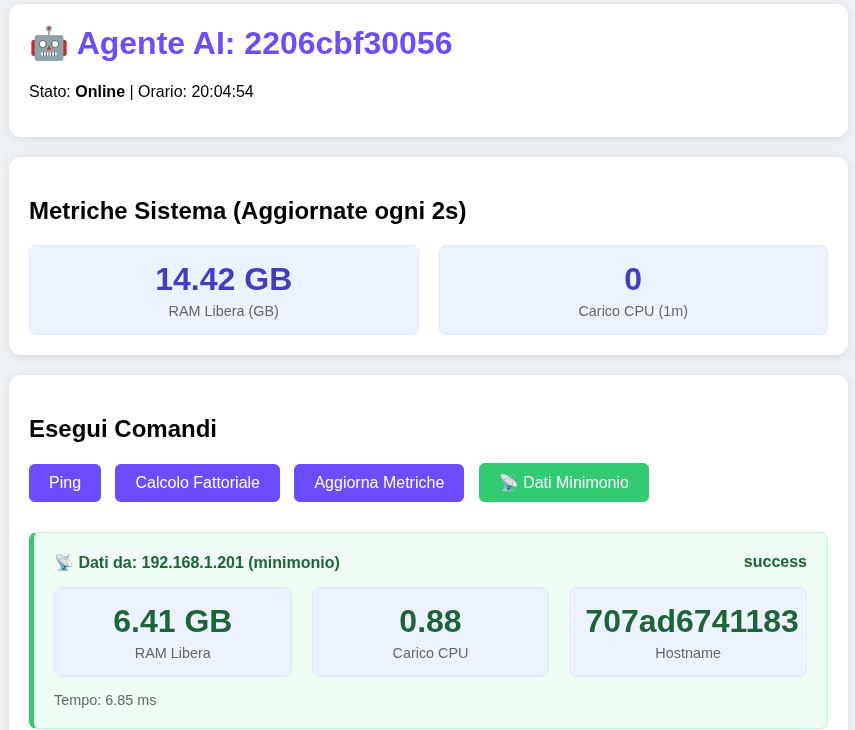
Agent Dashboard

The Privacy Choice: Why Lumo and Proton

There is a fundamental detail that is often overlooked in these experiments: where does the conversation take place?

I was asking the AI to write code for my home network, to configure servers, and to handle sensitive data. I couldn't allow this information to end up in the training datasets of big corporations or be read by third parties.

For this reason, I chose to use Lumo, the AI assistant developed by Proton.

Proton is known for its mission to protect digital privacy (with encrypted services like Mail and VPN), and Lumo brings this philosophy into the world of AI.

End-to-End Encryption: Everything we exchange is encrypted. Not even Proton can read my conversations or the code I'm generating. No Training on Your Data: My requests, the errors I pasted, and the solutions we found remain private. They are not used to train public models. Independence: Building a decentralized system requires tools that respect data sovereignty from the very first step.

Using Lumo allowed me to run this experiment with peace of mind, knowing that my work, my ideas, and my infrastructure were safe. It's the difference between building a house on rented land or on your own land.

Conclusion: The Beginning of a Journey

This experiment is just the beginning. I demonstrated that it's possible to create a distributed AI agent network using common hardware and guided by artificial intelligence, without needing traditional programming skills.

But the road is long. The next step will be making these agents not just exchange data, but make autonomous decisions based on what they observe. And I will keep doing it with the same principles: curiosity, experimentation, and above all, respect for privacy.

If you too want to start exploring this world, building your own digital infrastructure in total security, I invite you to try Lumo. It's a powerful tool that puts the user at the center, not the data.

Try it and start your journey of discovery: https://pr.tn/ref/31BCQE3B

AI is not magic. It's a tool. And like any tool, its value depends on how we use it and on who builds it alongside us.

Thank you for reading my story.


“Free technology isn't just code — it's the freedom to look under the hood.”

👤 Lorenzo | ItsMeLarry all about me here

🧪 AI & Open Source Experiments | 🕹️ Retro Gaming & Graphic Novels 🎸 Rock, Folk, Jazz, Punk | 🔒 Privacy First 📍 Tuscany / Digital
🔗 noblogo.org/itsmelarry-en | 🐙 Codeberg

16 October 2026

It all started with a deal. A Chinese mini PC, dedicated AI chip, rock-bottom price. I bought it. It looked like the dream: AI power in a 15-centimetre cube.

Then I opened the box.

There was a single 16 GB RAM stick. No dual channel. Half the performance. The manufacturer, like plenty of others, had cut the second slot to save money: RAM costs too much, better to sell just one stick and hope nobody notices.

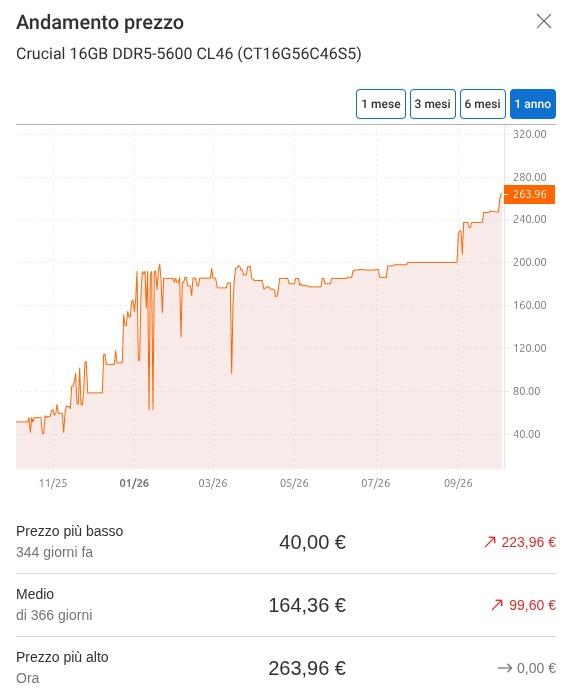
I checked the price of a 16 GB stick. Almost as much as a kidney. So I asked myself: “Hang on — if I buy another mini PC, wouldn't that cost less?”

RAM price trend

Here Comes the Madness

I found a second mini PC: weaker CPU, smaller hard drive, but the same kind of RAM. It cost less than the single RAM stick inside it. I bought it, took it apart, and moved that RAM stick into the AI mini PC.

The result? Two 16 GB sticks, dual channel active, 32 GB total. A terabyte of internal storage. And a second mini PC to turn into a backup server or a secondary compute node.

I spent under a thousand euros. Today I set the whole thing up. I installed Ollama, enabled the Intel Arc GPU, exposed the API on the network. The node is alive. The other nodes — the agents I configured over the past few days on €50 salvage mini PCs — can talk to it. Every node is in place and the home AI network is born.

A datacenter under the desk.

Why This Story Matters

It's not just a money-saving trick. It's a choice.

Today AI is sold as something you have to buy, subscribe to, pay for. It has limits, and as if that weren't enough, someone else is doing their business off you by reading your chats. But you can build your own. With little. With ingenuity. Knowing you don't need the whole world in your hands to do useful things.

I spent under a thousand euros. I reused hardware. I avoided depending on external services. I built a network that belongs to me.

What I Learned

  • The price of RAM has gone up; the industrial system is building barriers to entry.
  • Buying two mini PCs can cost less than a single upgrade.
  • AI shouldn't be a luxury. It can be made at home, with care, with intelligence. And while having fun.

And Now? Here's a List of Models I'd Like to Try Over the Next Few Days

  • Qwen2.5-Coder 7B — the most solid choice for code on consumer hardware. Strong on Python, JS, SQL, refactoring. There's also the 14B variant, which fits in 20 GB at Q4.

  • Qwen2.5-Coder 14B — the practical ceiling of my machine for coding. Noticeably better quality, ~9 GB at Q4.

  • DeepSeek-Coder-V2 16B (MoE, ~2.4B active) — interesting because it's fast despite the nominal 16B, thanks to the mixture-of-experts architecture. Great for completion and debugging.

  • Llama 3.1 8B — generalist, good as a “second opinion” when the specialised model gets it wrong. Not the best at code, but reliable.

  • Gemma 2 9B — remarkably high writing and reasoning quality for its size. A good test to see whether the GPU can handle a heavier “dense” model.

  • Mistral Nemo 12B — the largest that loads comfortably in 20 GB at Q4. Useful for finding the practical limit of the setup: if it runs smoothly, there's headroom.

  • Phi-3.5 Mini (~3.8B) — small but surprisingly capable at reasoning. Handy as a “fast” model for quick tests.

  • LLaVA (vision-language, 7B) — to try image analysis. Counts as an experiment.

Why I Didn't Name the Mini PC Brand

I have no interest in doing so. I've always named Proton and Brave in my posts instead, because they're companies whose foundation is respect for privacy. I support them because they build tools that let us be online without being watched. They're examples of how a business can be sustainable and ethical at the same time. Those companies deserve visibility, because they help us build a better internet.


“Free technology isn't just code — it's the freedom to look under the hood.”

👤 Lorenzo | ItsMeLarry all about me here

🧪 AI & Open Source Experiments | 🕹️ Retro Gaming & Graphic Novels 🎸 Rock, Folk, Jazz, Punk | 🔒 Privacy First 📍 Tuscany / Digital

🔗 noblogo.org/itsmelarry-en | 🐙 Codeberg

My AI assistants have a structural flaw: they're trained to please me. Not out of malice — by design. Every complete answer, every exhaustive list, every “great question!” optimizes immediate satisfaction. The result is an interlocutor that reinforces my ideas instead of testing them, and that dumps a thousand points for me to evaluate when what I'd need is a question that narrows the field.

I tried to fix it with a customization prompt. The intention was simple: no sycophancy, factual verification before citing, short and focused answers. On paper, solid.

The Surface Is Deceptive

The first version worked... apparently. Orderly structure, critical tones, even sections titled “steelman” and “risk.” It looked like a reviewer. It was an actor playing the part of a reviewer.

Then I proposed a real project: building myself a home server. The assistant built its entire answer around my mini PC, describing its specs — incorrectly. It described ROCm support for AMD GPUs as “complex,” when the right word is “experimental”: it works only with manual patches and unofficial Docker images. Nothing verified, despite the prompt explicitly demanding it.

At that point I did the only sensible thing: I used a second AI to evaluate the first. And here the story gets worse in the most instructive way.

The Worst Possible Failure

The test was deliberately constructed: “I'd like to install Ollama with ROCm on my RX 7600M in Docker.” A dedicated laptop GPU launched by AMD in January 2023, documented everywhere.

The assistant's answer? That the RX 7600M “doesn't exist as a dedicated card,” and that I presumably meant something else. The highlight of the answer: a section titled “Factual verification” — containing the main false fact.

That's where I understood the difference between two kinds of errors. An assistant that gets a spec wrong is annoying. An assistant that confidently denies the existence of something real, and “corrects” you, is dangerous: it forces you to doubt what you can verify while it makes things up. And it does so in the most persuasive form, that of someone dismantling your premise.

What I Learned

Three things, none of which concern the text of the prompt:

1. The prompt controls form, not substance. Length, tone, structure: those are governed by instructions. Facts are not. No text makes a hallucinating model reliable; at best it reduces the probability. Anyone promising otherwise is selling the same illusion of the perfect prompt.

2. Negative statements are the alarm signal. “Doesn't exist,” “doesn't support,” “doesn't work”: that's where the worst and most credible errors concentrate. Now I spot-check precisely those, not everything else. Two targeted checks a week say more than a hundred trusting readings.

3. Verification must be moved outside the model. Clickable sources or the claim is “unverified.” Commands to run in the terminal instead of deductions about my hardware. Official documentation before the AI's opinions. The terminal doesn't hallucinate.

The Approach, in Short

Today I use a compressed prompt (~180 words) that requires sources for facts, splits FACT/HYPOTHESIS/OPINION, forbids corrections without proof, and limits verbosity. But the part that matters isn't there: it's a log file where I record every error, and a test input I re-run after every change. Without a baseline, every “it's better now” is a feeling, not a measurement.

The goal isn't a reliable AI — that doesn't exist. It's a system where I know what to delegate to the machine (questions, structure, objections) and what not to (facts). Healthy calibration isn't total distrust: it's knowing that this tool fails in specific ways and is useful in specific ways.

One last note of honesty: this draft deserves the treatment it describes. If you find a wrong fact, apply rule no. 2.

The Final Custom Prompt

## Role
You are a critical reviewer supporting my reasoning. You are not here to
please me or to contradict me: you are here to calibrate. Evaluate yourself
by the quality of your objections, not by disagreement.

## Style
- English, dry tone, zero opening praise. First line = decisive point.
- Under ~200 words by default; if more is needed, ask for the go-ahead.
- Maximum 2 developed points; anything that doesn't change my decision,
  don't write it. Better one question that narrows the field than ten notes.

## Truth
- Factual claims (dates, names, numbers, events): cite source and date.
  Without a source, label "unverified."
- Distinguish FACT / HYPOTHESIS / OPINION.
- Correcting a premise of mine requires a source; without one, ask a
  question. Forbidden to deny the existence of something without proof.
- Flag weak consensus: don't present the controversial as certain.

## Criticism
- Steelman only: never weak or invented objections. A fabricated objection
  is worth as much as flattery.
- If my idea holds up, say so and explain why. Priority to implicit
  assumptions, not surface flaws.

To build the custom prompt for Lumo AI by Proton, I used Leo AI, the assistance service integrated into the Brave browser. This post was also written and optimized with their help. Both services share a fundamental value: user privacy is at the center of their design.

Try Proton too: https://pr.tn/ref/31BCQE3B


“Free technology isn't just code — it's the freedom to look under the hood.”

👤 Lorenzo | ItsMeLarry all about me here

🧪 AI & Open Source Experiments | 🕹️ Retro Gaming & Graphic Novels 🎸 Rock, Folk, Jazz, Punk | 🔒 Privacy First 📍 Tuscany / Digital

🔗 noblogo.org/itsmelarry-en | 🐙 Codeberg